Difference between revisions of "PrA"
KevinYager (talk | contribs) |
KevinYager (talk | contribs) (→Ellipse) |
||
| Line 52: | Line 52: | ||
\end{alignat} | \end{alignat} | ||
</math> | </math> | ||
| − | + | In particular: | |
| + | :<math> | ||
| + | \begin{alignat}{2} | ||
| + | \frac{(a+1) }{ \sqrt{a} } & = \mathrm{PRA} \\ | ||
| + | (a+1)^2 & = \mathrm{PRA}^2 a \\ | ||
| + | a^2+2a+1- \mathrm{PRA}^2 a & = 0 \\ | ||
| + | (1)a^2+(2-\mathrm{PRA}^2 )a+(1) & = 0 \\ | ||
| + | \end{alignat} | ||
| + | </math> | ||
| + | From the quadratic equation: | ||
| + | :<math> | ||
| + | \begin{alignat}{2} | ||
| + | a & = \frac{-(2-\mathrm{PRA}^2)\pm \sqrt{(2-\mathrm{PRA}^2)^2 - 4(1)(1)} }{2(1)} \\ | ||
| + | & = \frac{1}{2} \left( -2+\mathrm{PRA}^2\pm \sqrt{(2+\mathrm{PRA}^2)^2 - 4} \right)\\ | ||
| + | & = \frac{1}{2} \left( \mathrm{PRA}^2\pm \sqrt{(2+\mathrm{PRA}^2)^2 - 4} -2 \right)\\ | ||
| + | & = \frac{1}{2} \left( \mathrm{PRA}^2\pm \sqrt{(2+\mathrm{PRA}^2)^2 - 4} -2 \right)\\ | ||
| + | \end{alignat} | ||
| + | </math> | ||
| + | Since <math>a \to \infty</math> as <math>P \to \infty</math>, we select the positive branch. | ||
Revision as of 17:27, 12 May 2022
PrA is a simple ad-hoc parameter to define the "non-circularity" or eccentricity of a 2D object. This quantity is simply:
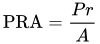
Where is the object's perimeter, is its surface area, and is an effective size (radius), computed based on the corresponding circle of the same area:


This definition of PrA is convenient, since it provides a simple measure of eccentricity. In particular, for a circle one expects:
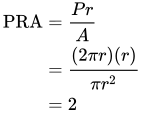
Since a circle has the minimal perimeter (for a given area), this is a limiting value of PrA:

And thus any non-circular object will have a larger PrA. An infinitely eccentric object would have .

Ellipse
If the object is an ellipse, with equation:
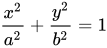
Then the width is and height (we assume ), the foci are for . The eccentricity is:


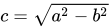
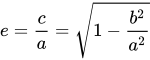
A circle has Failed to parse (Conversion error. Server ("https://wikimedia.org/api/rest_") reported: "Cannot get mml. Server problem."): {\displaystyle e=0} , while increasingly squashed ellipses have values of closer and closer to . The area of an ellipse is:


The perimeter is not analytic but can be approximated very roughly by:
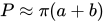
Which yields:
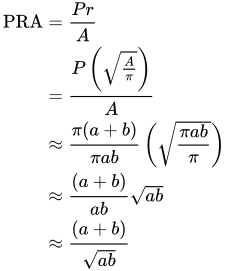
One can establish a relationship between eccentricity and PrA by setting and considering :

![{\displaystyle a\in [1,\infty ]}](https://wikimedia.org/api/rest_v1/media/math/render/svg/ea10524679a86b1a9006c09c759cee6ca74f2e8d)
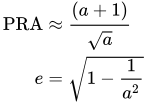
In particular:
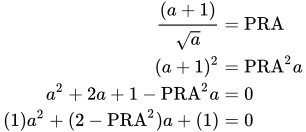
From the quadratic equation:
- Failed to parse (Conversion error. Server ("https://wikimedia.org/api/rest_") reported: "Cannot get mml. Server problem."): {\displaystyle {\begin{alignedat}{2}a&={\frac {-(2-\mathrm {PRA} ^{2})\pm {\sqrt {(2-\mathrm {PRA} ^{2})^{2}-4(1)(1)}}}{2(1)}}\\&={\frac {1}{2}}\left(-2+\mathrm {PRA} ^{2}\pm {\sqrt {(2+\mathrm {PRA} ^{2})^{2}-4}}\right)\\&={\frac {1}{2}}\left(\mathrm {PRA} ^{2}\pm {\sqrt {(2+\mathrm {PRA} ^{2})^{2}-4}}-2\right)\\&={\frac {1}{2}}\left(\mathrm {PRA} ^{2}\pm {\sqrt {(2+\mathrm {PRA} ^{2})^{2}-4}}-2\right)\\\end{alignedat}}}
Since as , we select the positive branch.


