|
|
| (10 intermediate revisions by 2 users not shown) |
| Line 1: |
Line 1: |
| | + | [[Image:Bcc02-unit cell.png|thumb|right|300px|Example of the [[Lattice:BCC|BCC]] unit cell.]] |
| | + | |
| | The '''unit cell''' is the basic building block of a crystal [[lattice]] (whether an atomic crystal or a nanoscale [[superlattice]]). Crystalline materials have a periodic structure, with the unit cell being the minimal volume necessary to fully describe the repeating structure. There are a finite number of possible symmetries for the repeating unit cell. | | The '''unit cell''' is the basic building block of a crystal [[lattice]] (whether an atomic crystal or a nanoscale [[superlattice]]). Crystalline materials have a periodic structure, with the unit cell being the minimal volume necessary to fully describe the repeating structure. There are a finite number of possible symmetries for the repeating unit cell. |
| | | | |
| − | ==Notation==
| + | A unit cell can be defined by three vectors that lie along the edges of the enclosing [http://en.wikipedia.org/wiki/Parallelepiped parallelepped]. We denote the vectors as <math>\mathbf{a}</math>, <math>\mathbf{b}</math>, and <math>\mathbf{c}</math>; alternately the unit cell can be described by the lengths of these vectors (<math>a</math>, <math>b</math>, <math>c</math>), and the angles between them: |
| − | * '''Real space''':
| + | : <math>\alpha</math>, the angle between <math>b</math> and <math>c</math> |
| − | ** Crystal ''planes'':
| + | : <math>\beta</math>, the angle between <math>a</math> and <math>c</math> |
| − | *** (hkl) denotes a plane of the crystal structure (and repetitions of that plane, with the given spacing). In cubic systems (but not others), the normal to the plane is [hkl]
| + | : <math>\gamma</math>, the angle between <math>a</math> and <math>b</math> |
| − | *** {hkl} denotes the set of all planes that are equivalent to (hkl) by the symmetry of the lattice
| |
| − | ** Crystal ''directions'':
| |
| − | *** [hkl] denotes a direction of a vector (in the basis of the direct lattice vectors)
| |
| − | *** <math>\left\langle hkl\right\rangle</math> denotes the set of all directions that are equivalent to [hkl] by symmetry (e.g. in cubic system <100> means [100, [010], [001], [-100], [0-10], [00-1])
| |
| − | ** hkl denotes a diffracting plane
| |
| − | | |
| | | | |
| − | * '''Reciprocal space''':
| |
| − | ** Reciprocal ''planes'':
| |
| − | *** [hkl] denotes a plane
| |
| − | *** <math>\left\langle hkl\right\rangle</math> denotes the set of all planes that are equivalent to [hkl]
| |
| − | ** Reciprocal ''directions'':
| |
| − | *** (hkl) denotes a particular direction (normal to plane (hkl) in real space)
| |
| − | *** {hkl} denotes the set of all directions that are equivalent to (hkl)
| |
| − | ** hkl denotes an indexed reflection
| |
| | | | |
| − | ==Math== | + | ==Mathematical description== |
| | ===Vectors=== | | ===Vectors=== |
| | + | There are many ways to define the Cartesian basis for the unit cell in [[real-space]]. A typical definition is: |
| | :<math>\begin{array}{l} | | :<math>\begin{array}{l} |
| | \mathbf{a} = \begin{bmatrix} | | \mathbf{a} = \begin{bmatrix} |
| Line 43: |
Line 32: |
| | c \frac{ \cos{\alpha} - \cos{\beta}\cos{\gamma} }{\sin{\gamma}} \\ | | c \frac{ \cos{\alpha} - \cos{\beta}\cos{\gamma} }{\sin{\gamma}} \\ |
| | c \sqrt{ 1 - \cos^2{\beta} - \left( \frac{\cos{\alpha} - \cos{\beta}\cos{\gamma}}{\sin{\gamma}} \right)^2 } | | c \sqrt{ 1 - \cos^2{\beta} - \left( \frac{\cos{\alpha} - \cos{\beta}\cos{\gamma}}{\sin{\gamma}} \right)^2 } |
| | + | \end{bmatrix} |
| | + | \end{array} |
| | + | </math> |
| | + | There are many mathematically equivalent ways to express a given definition. For instance, the vector <math>\mathbf{c}</math> can also be written as (c.f. [https://www.ocf.berkeley.edu/~rfu/notes/vect_unit_cells.pdf these notes] and [https://doi.org/10.1107/S0108767396005697 Trueblood et al. ''Acta Cryst'' '''1996''', A52, 770-781]): |
| | + | :<math>\begin{array}{l} |
| | + | \mathbf{c} = \begin{bmatrix} |
| | + | c \cos{\beta} \\ |
| | + | -c \sin \beta \cos \alpha^{*} \\ |
| | + | \frac{1}{c^{*}} \\ |
| | + | \end{bmatrix} |
| | + | = \begin{bmatrix} |
| | + | c \cos{\beta} \\ |
| | + | c \frac{\cos\alpha -\cos\beta \cos\gamma }{\sin\gamma} \\ |
| | + | \frac{c}{\sin\gamma} \sqrt{1 + 2 \cos\alpha\cos\beta\cos\gamma - \cos^2 \alpha - \cos^2\beta -\cos^2\gamma}\\ |
| | \end{bmatrix} | | \end{bmatrix} |
| | \end{array} | | \end{array} |
| Line 67: |
Line 70: |
| | * <math>\alpha</math> is the angle between <math>\mathbf{b}</math> and <math>\mathbf{c}</math> | | * <math>\alpha</math> is the angle between <math>\mathbf{b}</math> and <math>\mathbf{c}</math> |
| | | | |
| − | [[Image:Unit cell01.png|thumb|center|300px|From [http://en.wikipedia.org/wiki/Fractional_coordinates Fractional Coordinates (Wikipedia)]]] | + | [[Image:Unit cell01.png|center|thumb|300px|Unit cell definition using parallelepiped with lengths ''a'', ''b'', ''c'' and angles between the sides given by α,β,γ (from Wikipedia [http://en.wikipedia.org/wiki/Fractional_coordinates fractional coordinates]). ]] |
| | | | |
| − | ===Reciprocal Vectors=== | + | ===Reciprocal vectors=== |
| | + | The repeating structure of a unit cell creates peaks in [[reciprocal space]]. In particular, we observe maxima (constructive interference) when: |
| | + | :<math> |
| | + | \begin{alignat}{2} |
| | + | \mathbf{q} \cdot \mathbf{a} & = 2 \pi h \\ |
| | + | \mathbf{q} \cdot \mathbf{b} & = 2 \pi k \\ |
| | + | \mathbf{q} \cdot \mathbf{c} & = 2 \pi l \\ |
| | + | \end{alignat} |
| | + | </math> |
| | + | Where <math>h</math>, <math>k</math>, and <math>l</math> are integers. We define reciprocal-space vectors: |
| | :<math> | | :<math> |
| | \begin{alignat}{2} | | \begin{alignat}{2} |
| Line 77: |
Line 89: |
| | \end{alignat} | | \end{alignat} |
| | </math> | | </math> |
| − | | + | And we can then express the [[momentum transfer]] (<math>\mathbf{q}</math>) in terms of these reciprocal vectors: |
| − | ====Vector components====
| |
| − | Generally:
| |
| | :<math> | | :<math> |
| | \begin{alignat}{2} | | \begin{alignat}{2} |
| − | \mathbf{q}_{hkl} & = (2 \pi h)\mathbf{u} + (2 \pi k)\mathbf{v} + (2 \pi l)\mathbf{w} \\ | + | \mathbf{q} & = (\mathbf{q}\cdot\mathbf{a})\mathbf{u} + (\mathbf{q}\cdot\mathbf{b})\mathbf{v} + (\mathbf{q}\cdot\mathbf{c})\mathbf{w} |
| − | & = 2 \pi(h\mathbf{u} + k \mathbf{v} + l \mathbf{w}) \\
| |
| − | & = 2 \pi \mathbf{H}_{hkl}
| |
| | \end{alignat} | | \end{alignat} |
| | </math> | | </math> |
| − | With components:
| + | Combining with the three Laue equations yields: |
| | :<math> | | :<math> |
| | \begin{alignat}{2} | | \begin{alignat}{2} |
| − | \mathbf{u} & = ... \\ | + | \mathbf{q}_{hkl} & = (2 \pi h)\mathbf{u} + (2 \pi k)\mathbf{v} + (2 \pi l)\mathbf{w} \\ |
| − | \mathbf{v} & = ... \\
| + | & = 2 \pi(h\mathbf{u} + k \mathbf{v} + l \mathbf{w}) \\ |
| − | \mathbf{w} | + | & = 2 \pi \mathbf{H}_{hkl} |
| − | & = \frac{\mathbf{a}\times\mathbf{b}}{\mathbf{a}\cdot (\mathbf{b}\times\mathbf{c}) } \\
| |
| − | & =\frac{1}{V} \mathbf{a}\times\mathbf{b} \\
| |
| − | & =\frac{1}{V} \begin{bmatrix} 0 \\ 0 \\ a b \sin{\gamma} \end{bmatrix} \\
| |
| | \end{alignat} | | \end{alignat} |
| | </math> | | </math> |
| | + | Where <math>\mathbf{H}_{hkl}</math> is a vector that defines the position of [[Bragg's law|Bragg reflection]] <math>hkl</math> for the reciprocal-lattice. |
| | | | |
| | ==Examples== | | ==Examples== |
| Line 139: |
Line 145: |
| | & = \begin{bmatrix} \frac{2 \pi h}{a} \\ \frac{2 \pi k}{b} \\ \frac{2 \pi l}{c} \end{bmatrix} | | & = \begin{bmatrix} \frac{2 \pi h}{a} \\ \frac{2 \pi k}{b} \\ \frac{2 \pi l}{c} \end{bmatrix} |
| | \end{alignat} | | \end{alignat} |
| | + | </math> |
| | + | And: |
| | + | :<math> |
| | + | q_{hkl} = 2\pi \sqrt{ \left( \frac{h}{a} \right)^2 + \left( \frac{k}{b} \right)^2 + \left( \frac{l}{c} \right)^2 } |
| | </math> | | </math> |
| | | | |
| Line 182: |
Line 192: |
| | \end{alignat} | | \end{alignat} |
| | </math> | | </math> |
| | + | |
| | + | ==See Also== |
| | + | * [[Lattices]] |
| | + | * K. N. Trueblood, H.-B. Bürgi, H. Burzlaff, J. D. Dunitz, C. M. Gramaccioli, H. H. Schulz, U. Shmueli and S. C. Abrahams [https://scripts.iucr.org/cgi-bin/paper?S0108767396005697 Atomic Dispacement Parameter Nomenclature. Report of a Subcommittee on Atomic Displacement Parameter Nomenclature] ''Acta Cryst'' '''1996''', A52, 770-781. [https://doi.org/10.1107/S0108767396005697 doi: 10.1107/S0108767396005697] |
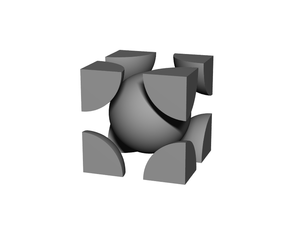
Example of the
BCC unit cell.
The unit cell is the basic building block of a crystal lattice (whether an atomic crystal or a nanoscale superlattice). Crystalline materials have a periodic structure, with the unit cell being the minimal volume necessary to fully describe the repeating structure. There are a finite number of possible symmetries for the repeating unit cell.
A unit cell can be defined by three vectors that lie along the edges of the enclosing parallelepped. We denote the vectors as  ,
,  , and
, and  ; alternately the unit cell can be described by the lengths of these vectors (
 ,
,  ,
,  ), and the angles between them:
 , the angle between and
  , the angle between and
  , the angle between and
Mathematical description
Vectors
There are many ways to define the Cartesian basis for the unit cell in real-space. A typical definition is:
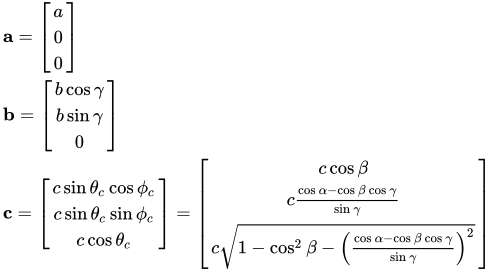
There are many mathematically equivalent ways to express a given definition. For instance, the vector can also be written as (c.f. these notes and Trueblood et al. Acta Cryst 1996, A52, 770-781):

Relations



Volume

If a, b, and c are the parallelepiped edge lengths, and α, β, and γ are the internal angles between the edges, the volume is

The volume of a unit cell with all edge-length equal to unity is:

Angles
- is the angle between and
- is the angle between and
- is the angle between and
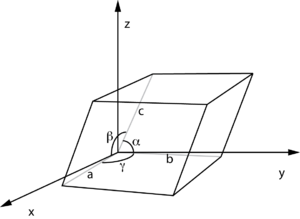
Unit cell definition using parallelepiped with lengths
a,
b,
c and angles between the sides given by α,β,γ (from Wikipedia
fractional coordinates).
Reciprocal vectors
The repeating structure of a unit cell creates peaks in reciprocal space. In particular, we observe maxima (constructive interference) when:

Where  ,
,  , and
, and  are integers. We define reciprocal-space vectors:
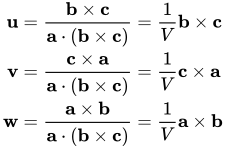
And we can then express the momentum transfer ( ) in terms of these reciprocal vectors:

Combining with the three Laue equations yields:
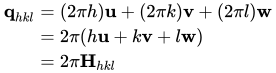
Where  is a vector that defines the position of Bragg reflection
  for the reciprocal-lattice.
Examples
Cubic
Since  ,
,  , and:
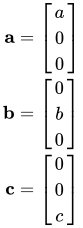
And in reciprocal-space:
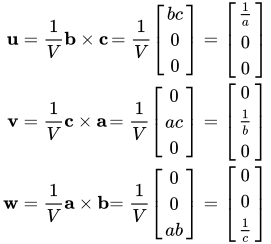
So:
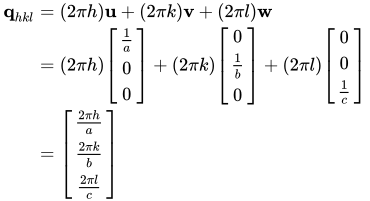
And:
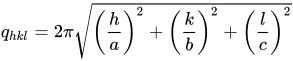
Hexagonal
Since  and
and  ,
,  , and:
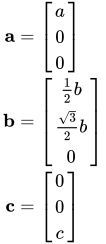
And in reciprocal-space:
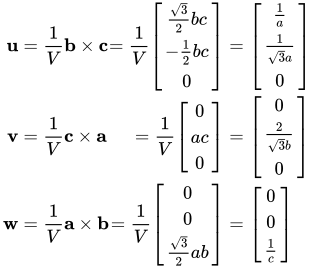
So:
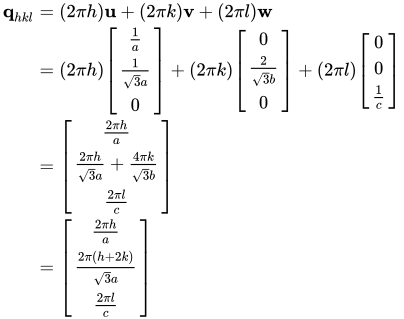
See Also


