|
|
| (One intermediate revision by the same user not shown) |
| Line 1: |
Line 1: |
| − | In cases of strongly scattering or absorbing samples, the detected scattering intensity is lower than the 'true' scattering. Moreover, for oddly-shaped samples, the extinction of scattering may be anisotropic: some parts of the detector image are more attenuated than others because of the differing path-lengths through the sample. | + | In cases of strongly scattering or [[absorbing]] samples, the detected scattering intensity is lower than the 'true' scattering. Moreover, for oddly-shaped samples, the extinction of scattering may be anisotropic: some parts of the detector image are more attenuated than others because of the differing path-lengths through the sample. |
| | + | |
| | + | ==Formulation== |
| | + | In the following, we assume a transmission-scattering (TSAXS) experiment. |
| | | | |
| | The measured scattering, <math>S_m</math>, at a particular scattering angle <math>(\Theta_o, \chi_o)</math> (where <math>\Theta_o</math> is the full (<math>2 \theta</math>) scattering angle between the scattered ray and the incident beam, and <math>\chi_o</math> is the azimuthal angle: <math>\chi=0^{\circ}</math> corresponds to the <math>q_z</math> axis, whereas <math>\chi=90^{\circ}</math> is along the <math>q_r</math> axis) can be computed by summing the scattering contributions for all the elements along the beam path through the sample. | | The measured scattering, <math>S_m</math>, at a particular scattering angle <math>(\Theta_o, \chi_o)</math> (where <math>\Theta_o</math> is the full (<math>2 \theta</math>) scattering angle between the scattered ray and the incident beam, and <math>\chi_o</math> is the azimuthal angle: <math>\chi=0^{\circ}</math> corresponds to the <math>q_z</math> axis, whereas <math>\chi=90^{\circ}</math> is along the <math>q_r</math> axis) can be computed by summing the scattering contributions for all the elements along the beam path through the sample. |
In cases of strongly scattering or absorbing samples, the detected scattering intensity is lower than the 'true' scattering. Moreover, for oddly-shaped samples, the extinction of scattering may be anisotropic: some parts of the detector image are more attenuated than others because of the differing path-lengths through the sample.
Formulation
In the following, we assume a transmission-scattering (TSAXS) experiment.
The measured scattering,  , at a particular scattering angle
  (where
  is the full (
 ) scattering angle between the scattered ray and the incident beam, and
  is the azimuthal angle:
  corresponds to the
  axis, whereas
  is along the
  axis) can be computed by summing the scattering contributions for all the elements along the beam path through the sample.
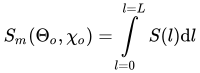
We define a realspace coordinate system  where z points vertically, y points along the beam direction, and x points horizontally with respect to the sample. Let the sample size along the beam direction be L. Defining the point where the beam first enters the sample as
  we write:
The scattering from a particular location within the sample is affected by two attenuation effects:
- The beam flux within the sample decreases due to absorption/scattering, such that the flux at position
 is not the incident flux,
  but attenuated to:
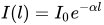
- where
 is (Beer-Lambert like) extinction coefficient. If the 'true' scattering probability is given by
  (i.e.
(i.e.  is the scattering observed in the absence of attenuation), then the scattering at is:

- The scattered radiation is itself attenuated as it passes through the sample. Let this path-length (from scattering location
 until it exits the sample along the direction ) be denoted
  . In such a case, the scattering that exits the sample is:
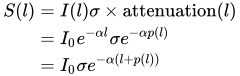
The measured scattering is thus:

The integral of course depends on the form of which depends on the sample shape. Note that in the limiting case of weak attenuation ( ), we obtain the very simple result:

As expected, scattering intensity scales with the scattering volume.
Normalization
To normalize-out the effect of attenuation, one can simply divide by the integral:
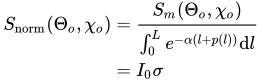
Of course in the case of weak attenuation the integral is simply L, and we are normalizing by the beam-path through the sample.
Coordinates
For a vector that starts at and terminates at , pointing along direction , the full length is:

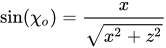
We can consider triangles in various planes:
- xz plane (looking along beam):

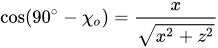
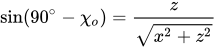
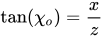
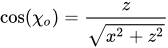
- xy plane (looking from above):
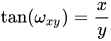
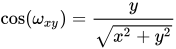
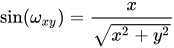
- yz plane (looking from side):
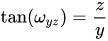
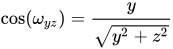
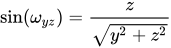
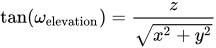
- plane of beam elevation:
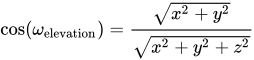

- plane of full scattering angle:
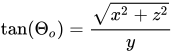
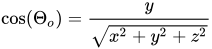
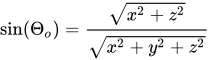
Height Z
If the vector's final point is at height  :
:

This has a minimum of  when
when  .
.
Depth L
If the vector's final position is at depth  :
:
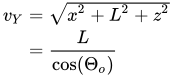
This has a minimum of  when
when  .
.
Width X
If the vector's final position is at width  :
:
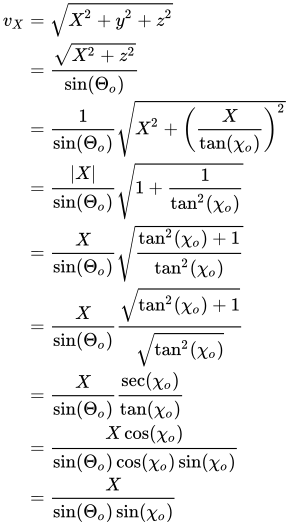
This has a minimum of  when
when  .
.
Rectangular prism
If the sample is a rectangular prism with dimensions  and the beam falls upon the center of the xz front-face, then the beam travels a distance L through the sample, and the scattered radiation in any quadrant passes through the rectangular prism of size
  . The distance from to the exit-point from the sample is the distance to the closest sample face:

The distances are:
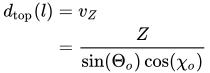
- Failed to parse (MathML with SVG or PNG fallback (recommended for modern browsers and accessibility tools): Invalid response ("Math extension cannot connect to Restbase.") from server "https://wikimedia.org/api/rest_v1/":): {\displaystyle \begin{alignat}{2} d_{\mathrm{back}}(l) & = v_{L-l} \\ & = \frac{ L-l }{ \cos(\Theta_o) } \\ \end{alignat} }
- Failed to parse (MathML with SVG or PNG fallback (recommended for modern browsers and accessibility tools): Invalid response ("Math extension cannot connect to Restbase.") from server "https://wikimedia.org/api/rest_v1/":): {\displaystyle \begin{alignat}{2} d_{\mathrm{side}}(l) & = v_X \\ & = \frac{ X }{ \sin(\Theta_o) \sin(\chi_o) } \\ \end{alignat} }

