Difference between revisions of "Unit cell"
KevinYager (talk | contribs) (→Reciprocal vectors) |
KevinYager (talk | contribs) (→Vectors) |
||
| (One intermediate revision by the same user not shown) | |||
| Line 11: | Line 11: | ||
==Mathematical description== | ==Mathematical description== | ||
===Vectors=== | ===Vectors=== | ||
| + | There are many ways to define the Cartesian basis for the unit cell in [[real-space]]. A typical definition is: | ||
:<math>\begin{array}{l} | :<math>\begin{array}{l} | ||
\mathbf{a} = \begin{bmatrix} | \mathbf{a} = \begin{bmatrix} | ||
| Line 31: | Line 32: | ||
c \frac{ \cos{\alpha} - \cos{\beta}\cos{\gamma} }{\sin{\gamma}} \\ | c \frac{ \cos{\alpha} - \cos{\beta}\cos{\gamma} }{\sin{\gamma}} \\ | ||
c \sqrt{ 1 - \cos^2{\beta} - \left( \frac{\cos{\alpha} - \cos{\beta}\cos{\gamma}}{\sin{\gamma}} \right)^2 } | c \sqrt{ 1 - \cos^2{\beta} - \left( \frac{\cos{\alpha} - \cos{\beta}\cos{\gamma}}{\sin{\gamma}} \right)^2 } | ||
| + | \end{bmatrix} | ||
| + | \end{array} | ||
| + | </math> | ||
| + | There are many mathematically equivalent ways to express a given definition. For instance, the vector <math>\mathbf{c}</math> can also be written as (c.f. [https://www.ocf.berkeley.edu/~rfu/notes/vect_unit_cells.pdf these notes] and [https://doi.org/10.1107/S0108767396005697 Trueblood et al. ''Acta Cryst'' '''1996''', A52, 770-781]): | ||
| + | :<math>\begin{array}{l} | ||
| + | \mathbf{c} = \begin{bmatrix} | ||
| + | c \cos{\beta} \\ | ||
| + | -c \sin \beta \cos \alpha^{*} \\ | ||
| + | \frac{1}{c^{*}} \\ | ||
| + | \end{bmatrix} | ||
| + | = \begin{bmatrix} | ||
| + | c \cos{\beta} \\ | ||
| + | c \frac{\cos\alpha -\cos\beta \cos\gamma }{\sin\gamma} \\ | ||
| + | \frac{c}{\sin\gamma} \sqrt{1 + 2 \cos\alpha\cos\beta\cos\gamma - \cos^2 \alpha - \cos^2\beta -\cos^2\gamma}\\ | ||
\end{bmatrix} | \end{bmatrix} | ||
\end{array} | \end{array} | ||
| Line 180: | Line 195: | ||
==See Also== | ==See Also== | ||
* [[Lattices]] | * [[Lattices]] | ||
| + | * K. N. Trueblood, H.-B. Bürgi, H. Burzlaff, J. D. Dunitz, C. M. Gramaccioli, H. H. Schulz, U. Shmueli and S. C. Abrahams [https://scripts.iucr.org/cgi-bin/paper?S0108767396005697 Atomic Dispacement Parameter Nomenclature. Report of a Subcommittee on Atomic Displacement Parameter Nomenclature] ''Acta Cryst'' '''1996''', A52, 770-781. [https://doi.org/10.1107/S0108767396005697 doi: 10.1107/S0108767396005697] | ||
Latest revision as of 10:33, 14 November 2022

The unit cell is the basic building block of a crystal lattice (whether an atomic crystal or a nanoscale superlattice). Crystalline materials have a periodic structure, with the unit cell being the minimal volume necessary to fully describe the repeating structure. There are a finite number of possible symmetries for the repeating unit cell.
A unit cell can be defined by three vectors that lie along the edges of the enclosing parallelepped. We denote the vectors as Failed to parse (MathML with SVG or PNG fallback (recommended for modern browsers and accessibility tools): Invalid response ("Math extension cannot connect to Restbase.") from server "https://wikimedia.org/api/rest_v1/":): {\displaystyle \mathbf{a}} , Failed to parse (MathML with SVG or PNG fallback (recommended for modern browsers and accessibility tools): Invalid response ("Math extension cannot connect to Restbase.") from server "https://wikimedia.org/api/rest_v1/":): {\displaystyle \mathbf{b}} , and Failed to parse (MathML with SVG or PNG fallback (recommended for modern browsers and accessibility tools): Invalid response ("Math extension cannot connect to Restbase.") from server "https://wikimedia.org/api/rest_v1/":): {\displaystyle \mathbf{c}} ; alternately the unit cell can be described by the lengths of these vectors (, , ), and the angles between them:


- , the angle between and
- , the angle between and
- , the angle between and


Contents
Mathematical description
Vectors
There are many ways to define the Cartesian basis for the unit cell in real-space. A typical definition is:
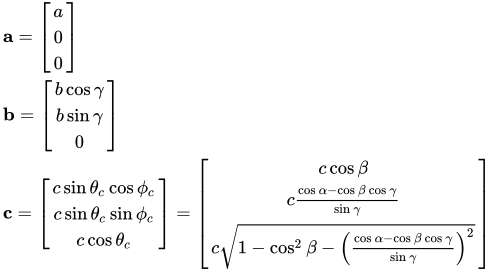
There are many mathematically equivalent ways to express a given definition. For instance, the vector can also be written as (c.f. these notes and Trueblood et al. Acta Cryst 1996, A52, 770-781):


Relations



Volume

If a, b, and c are the parallelepiped edge lengths, and α, β, and γ are the internal angles between the edges, the volume is

The volume of a unit cell with all edge-length equal to unity is:

Angles
- is the angle between and
- is the angle between and
- is the angle between and


Reciprocal vectors
The repeating structure of a unit cell creates peaks in reciprocal space. In particular, we observe maxima (constructive interference) when:

Where , , and are integers. We define reciprocal-space vectors:


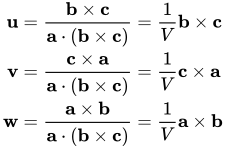
And we can then express the momentum transfer () in terms of these reciprocal vectors:


Combining with the three Laue equations yields:
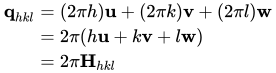
Where is a vector that defines the position of Bragg reflection for the reciprocal-lattice.


Examples
Cubic
Since , , and:


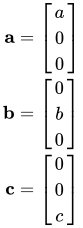
And in reciprocal-space:
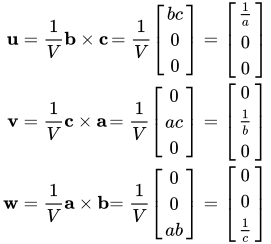
So:
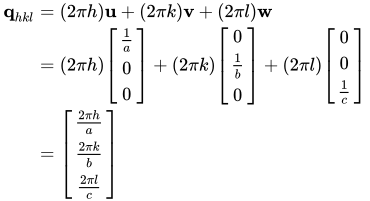
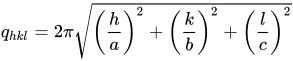
And:
Hexagonal
Since and Failed to parse (MathML with SVG or PNG fallback (recommended for modern browsers and accessibility tools): Invalid response ("Math extension cannot connect to Restbase.") from server "https://wikimedia.org/api/rest_v1/":): {\displaystyle \gamma=60^{\circ}} , Failed to parse (MathML with SVG or PNG fallback (recommended for modern browsers and accessibility tools): Invalid response ("Math extension cannot connect to Restbase.") from server "https://wikimedia.org/api/rest_v1/":): {\displaystyle V=\frac{\sqrt{3}}{2}abc} , and:

- Failed to parse (MathML with SVG or PNG fallback (recommended for modern browsers and accessibility tools): Invalid response ("Math extension cannot connect to Restbase.") from server "https://wikimedia.org/api/rest_v1/":): {\displaystyle \begin{alignat}{2} \mathbf{a} & = \begin{bmatrix} a \\ 0 \\ 0 \end{bmatrix} \\ \mathbf{b} & = \begin{bmatrix} \frac{1}{2}b \\ \frac{\sqrt{3}}{2} b \\ 0 \end{bmatrix} \\ \mathbf{c} & = \begin{bmatrix} 0 \\ 0 \\ c \end{bmatrix} \\ \end{alignat} }
And in reciprocal-space:
- Failed to parse (MathML with SVG or PNG fallback (recommended for modern browsers and accessibility tools): Invalid response ("Math extension cannot connect to Restbase.") from server "https://wikimedia.org/api/rest_v1/":): {\displaystyle \begin{alignat}{2} \mathbf{u} & =\frac{1}{V} \mathbf{b}\times\mathbf{c} & =\frac{1}{V} \begin{bmatrix} \frac{\sqrt{3}}{2} b c \\ -\frac{1}{2} b c \\ 0 \end{bmatrix} & = \begin{bmatrix} \frac{1}{a} \\ \frac{1}{\sqrt{3}a} \\ 0 \end{bmatrix}\\ \mathbf{v} & =\frac{1}{V} \mathbf{c}\times\mathbf{a} & =\frac{1}{V} \begin{bmatrix} 0 \\ a c \\ 0 \end{bmatrix} & = \begin{bmatrix} 0 \\ \frac{2}{\sqrt{3}b} \\ 0 \end{bmatrix}\\ \mathbf{w} & =\frac{1}{V} \mathbf{a}\times\mathbf{b} & =\frac{1}{V} \begin{bmatrix} 0 \\ 0 \\ \frac{\sqrt{3}}{2} a b \end{bmatrix} & = \begin{bmatrix} 0 \\ 0 \\ \frac{1}{c} \end{bmatrix}\\ \end{alignat} }
So:
- Failed to parse (MathML with SVG or PNG fallback (recommended for modern browsers and accessibility tools): Invalid response ("Math extension cannot connect to Restbase.") from server "https://wikimedia.org/api/rest_v1/":): {\displaystyle \begin{alignat}{2} \mathbf{q}_{hkl} & = (2 \pi h)\mathbf{u} + (2 \pi k)\mathbf{v} + (2 \pi l)\mathbf{w} \\ & = (2 \pi h)\begin{bmatrix} \frac{1}{a} \\ \frac{1}{\sqrt{3}a} \\ 0 \end{bmatrix} + (2 \pi k)\begin{bmatrix} 0 \\ \frac{2}{\sqrt{3}b} \\ 0 \end{bmatrix} + (2 \pi l)\begin{bmatrix} 0 \\ 0 \\ \frac{1}{c} \end{bmatrix} \\ & = \begin{bmatrix} \frac{2 \pi h}{a} \\ \frac{2 \pi h}{\sqrt{3}a} + \frac{4 \pi k}{\sqrt{3}b} \\ \frac{2 \pi l}{c} \end{bmatrix} \\ & = \begin{bmatrix} \frac{2 \pi h}{a} \\ \frac{2 \pi (h + 2 k)}{\sqrt{3}a} \\ \frac{2 \pi l}{c} \end{bmatrix} \end{alignat} }
See Also
- Lattices
- K. N. Trueblood, H.-B. Bürgi, H. Burzlaff, J. D. Dunitz, C. M. Gramaccioli, H. H. Schulz, U. Shmueli and S. C. Abrahams Atomic Dispacement Parameter Nomenclature. Report of a Subcommittee on Atomic Displacement Parameter Nomenclature Acta Cryst 1996, A52, 770-781. doi: 10.1107/S0108767396005697

