Difference between revisions of "Quantum Mechanics"

From GISAXS
Jump to: navigation, search
(Superposition)
(Superposition)
Line 57: Line 57:
 
\end{alignat}
 
\end{alignat}
 
</math>
 
</math>
Notice that the final terms represent 'interference' between the two constituent states. This interference has no classical analogue; it is a quantum effect. Thus a superposition is not merely a 'joining' of the two states (e.g. "the particle can be in state 1 or state 2"), but a truly coherent interference between the two states.
+
Notice that the final terms represent 'interference' between the two constituent states. This interference has no classical analogue; it is a quantum effect. Thus a superposition is not merely a 'joining' of the two states (e.g. "the particle can be in state 1 or state 2"), but a truly coherent interference between the two states. The superposition may be more generally written as:
  
 
==See Also==
 
==See Also==
 
* [http://en.wikipedia.org/wiki/Quantum_mechanics Wikipedia: Quantum Mechanics]
 
* [http://en.wikipedia.org/wiki/Quantum_mechanics Wikipedia: Quantum Mechanics]

Revision as of 19:14, 12 October 2014

Quantum mechanics is a theory that describes the interactions of all particles and systems. It underlies all physical phenomena, including scattering.


Wavefunction

A quantum system is completely specified by its Wave Function:

Failed to parse (MathML with SVG or PNG fallback (recommended for modern browsers and accessibility tools): Invalid response ("Math extension cannot connect to Restbase.") from server "https://wikimedia.org/api/rest_v1/":): {\displaystyle \psi(x) }

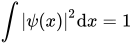
The wavefunction is typically normalized:

Integral Notation Dirac Notation
 Failed to parse (MathML with SVG or PNG fallback (recommended for modern browsers and accessibility tools): Invalid response ("Math extension cannot connect to Restbase.") from server "https://wikimedia.org/api/rest_v1/":): {\displaystyle \int | \psi(x) |^2 \mathrm{d}x = 1}     

The distribution of the particle described by Failed to parse (MathML with SVG or PNG fallback (recommended for modern browsers and accessibility tools): Invalid response ("Math extension cannot connect to Restbase.") from server "https://wikimedia.org/api/rest_v1/":): {\displaystyle \psi(x)} is given by:

Integral Notation Dirac Notation
 Failed to parse (MathML with SVG or PNG fallback (recommended for modern browsers and accessibility tools): Invalid response ("Math extension cannot connect to Restbase.") from server "https://wikimedia.org/api/rest_v1/":): {\displaystyle \Pr(x) \mathrm{d}x = | \psi(x) |^2 }    Failed to parse (MathML with SVG or PNG fallback (recommended for modern browsers and accessibility tools): Invalid response ("Math extension cannot connect to Restbase.") from server "https://wikimedia.org/api/rest_v1/":): {\displaystyle |\langle x | \psi \rangle |^2 }  

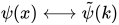
In the Copenhagen Interpretation, Failed to parse (MathML with SVG or PNG fallback (recommended for modern browsers and accessibility tools): Invalid response ("Math extension cannot connect to Restbase.") from server "https://wikimedia.org/api/rest_v1/":): {\displaystyle \Pr(x)} is the probability of finding the particle at location Failed to parse (MathML with SVG or PNG fallback (recommended for modern browsers and accessibility tools): Invalid response ("Math extension cannot connect to Restbase.") from server "https://wikimedia.org/api/rest_v1/":): {\displaystyle x} . In Universal Wave Function interpretations (e.g. MWI), Failed to parse (MathML with SVG or PNG fallback (recommended for modern browsers and accessibility tools): Invalid response ("Math extension cannot connect to Restbase.") from server "https://wikimedia.org/api/rest_v1/":): {\displaystyle \Pr(x)} can be thought of as the spatial distribution of the particle. The wavefunction contains all the information one can know about a system. It can thus be thought of as 'being' the particle/system in question. However, the wavefunction can be described in an infinite number of different ways. That is, there is not a unique basis for describing the wavefunction. So, for instance, one can describe the wavefunction using position-space or momentum-space:

Failed to parse (MathML with SVG or PNG fallback (recommended for modern browsers and accessibility tools): Invalid response ("Math extension cannot connect to Restbase.") from server "https://wikimedia.org/api/rest_v1/":): {\displaystyle \psi(x) \longleftrightarrow \tilde{\psi} (k) }

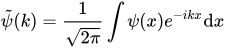
These representations can be inter-related (c.f. Fourier transform):
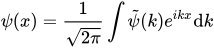
Failed to parse (MathML with SVG or PNG fallback (recommended for modern browsers and accessibility tools): Invalid response ("Math extension cannot connect to Restbase.") from server "https://wikimedia.org/api/rest_v1/":): {\displaystyle \psi(x) = \frac{1}{\sqrt{2 \pi}} \int \tilde{\psi}(k) e^{i k x } \mathrm{d}k }
Failed to parse (MathML with SVG or PNG fallback (recommended for modern browsers and accessibility tools): Invalid response ("Math extension cannot connect to Restbase.") from server "https://wikimedia.org/api/rest_v1/":): {\displaystyle \tilde{\psi}(k) = \frac{1}{\sqrt{2 \pi}} \int {\psi}(x) e^{-i k x } \mathrm{d}x }

Wave packet

TBD

Heisenberg Indeterminacy Relations

(Also known as Heisenberg Uncertainty Principle.)

Failed to parse (MathML with SVG or PNG fallback (recommended for modern browsers and accessibility tools): Invalid response ("Math extension cannot connect to Restbase.") from server "https://wikimedia.org/api/rest_v1/":): {\displaystyle \Delta_{x}\Delta_{p} \geq \frac{\hbar}{2}}
Failed to parse (MathML with SVG or PNG fallback (recommended for modern browsers and accessibility tools): Invalid response ("Math extension cannot connect to Restbase.") from server "https://wikimedia.org/api/rest_v1/":): {\displaystyle \Delta_{E}\Delta_{t} \geq \frac{\hbar}{2}}

Superposition

If Failed to parse (MathML with SVG or PNG fallback (recommended for modern browsers and accessibility tools): Invalid response ("Math extension cannot connect to Restbase.") from server "https://wikimedia.org/api/rest_v1/":): {\displaystyle \psi_1(x)} and Failed to parse (MathML with SVG or PNG fallback (recommended for modern browsers and accessibility tools): Invalid response ("Math extension cannot connect to Restbase.") from server "https://wikimedia.org/api/rest_v1/":): {\displaystyle \psi_2(x)} are both allowed states for a given system, then the following state is also allowed:

Failed to parse (MathML with SVG or PNG fallback (recommended for modern browsers and accessibility tools): Invalid response ("Math extension cannot connect to Restbase.") from server "https://wikimedia.org/api/rest_v1/":): {\displaystyle \psi(x) = \alpha \psi_1(x) + \beta \psi_2(x) }

This leads to a notable consequence:

Failed to parse (MathML with SVG or PNG fallback (recommended for modern browsers and accessibility tools): Invalid response ("Math extension cannot connect to Restbase.") from server "https://wikimedia.org/api/rest_v1/":): {\displaystyle \begin{alignat}{2} \Pr(x) & = | \alpha \psi_1(x) + \beta \psi_2(x) |^2 \\ & = (\alpha\psi_1 + \beta\psi_2)(\alpha\psi_1 + \beta\psi_2)^{*} \\ & = |\alpha|^2 |\psi_1|^2 + |\beta|^2\psi_2^2 + \alpha\beta^* \psi_1\psi_2^* + \alpha^*\beta\psi_1^*\psi_2 \\ & = \mathrm{Pr}_1(x) + \mathrm{Pr}_2(x) + \mathrm{interference} \\ \end{alignat} }

Notice that the final terms represent 'interference' between the two constituent states. This interference has no classical analogue; it is a quantum effect. Thus a superposition is not merely a 'joining' of the two states (e.g. "the particle can be in state 1 or state 2"), but a truly coherent interference between the two states. The superposition may be more generally written as:

See Also