Difference between revisions of "Paper:DNA-nanoparticle superlattices formed from anisotropic building blocks"
KevinYager (talk | contribs) (→Summary of Mathematics) |
KevinYager (talk | contribs) |
||
| Line 2: | Line 2: | ||
* Matthew R. Jones, Robert J. Macfarlane, Byeongdu Lee, Jian Zhang, Kaylie L. Young, Andrew J. Senesi, and Chad A. Mirkin [http://www.nature.com/nmat/journal/v9/n11/full/nmat2870.html DNA-nanoparticle superlattices formed from anisotropic building blocks] ''Nature Materials'' '''2010''', ''9'', 913-917 [http://dx.doi.org/10.1038/nmat2870 doi: 10.1038/nmat2870] | * Matthew R. Jones, Robert J. Macfarlane, Byeongdu Lee, Jian Zhang, Kaylie L. Young, Andrew J. Senesi, and Chad A. Mirkin [http://www.nature.com/nmat/journal/v9/n11/full/nmat2870.html DNA-nanoparticle superlattices formed from anisotropic building blocks] ''Nature Materials'' '''2010''', ''9'', 913-917 [http://dx.doi.org/10.1038/nmat2870 doi: 10.1038/nmat2870] | ||
| − | This paper describes the formation of nanoparticle [[superlattices] from anisotropic nano-objects. In the [http://www.nature.com/nmat/journal/v9/n11/extref/nmat2870-s1.pdf Supplementary Information] information, the authors describe how to model x-ray scattering data from [[lattice]]s of anisotropic nanoparticles. | + | This paper describes the formation of nanoparticle [[superlattices]] from anisotropic nano-objects. In the [http://www.nature.com/nmat/journal/v9/n11/extref/nmat2870-s1.pdf Supplementary Information] information, the authors describe how to model x-ray scattering data from [[lattice]]s of anisotropic nanoparticles. |
===Summary of Mathematics=== | ===Summary of Mathematics=== | ||
Revision as of 15:21, 3 December 2014
This is a summary/discussion of the results from:
- Matthew R. Jones, Robert J. Macfarlane, Byeongdu Lee, Jian Zhang, Kaylie L. Young, Andrew J. Senesi, and Chad A. Mirkin DNA-nanoparticle superlattices formed from anisotropic building blocks Nature Materials 2010, 9, 913-917 doi: 10.1038/nmat2870
This paper describes the formation of nanoparticle superlattices from anisotropic nano-objects. In the Supplementary Information information, the authors describe how to model x-ray scattering data from lattices of anisotropic nanoparticles.
Summary of Mathematics
Randomly oriented crystals give scattering intensity:
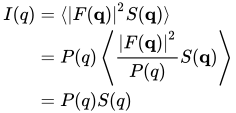
Where the structure factor is defined by an orientational average (randomly oriented crystal(s)):

and can be computed by:

Where c is a constant, and L is the peak shape; such as:

The (isotropic) form factor intensity is an average over all possible particle orientations:
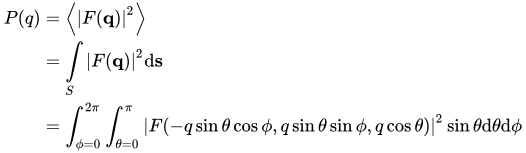
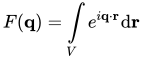
The form factor amplitude is computed via:
Form Factors
The SI also provides form factors for a variety of nano-object shapes:
- Pyramid
- Cube
- Cylinder
- Octahedron
- Rhombic dodecahedron (RD)
- Triangular prism

