Scattering

Scattering broadly refers to experimental techniques that use the interaction between radiation and matter to elucidate structure. In x-ray scattering, a collimated x-ray beam is directed at a sample of interest. The incident x-rays scatter off of all the atoms/particles in the sample. Because of the wavelike nature of x-rays (which are simply high-energy photons; i.e. electromagnetic rays), the scattered waves interfere with one another, leading to constructive interference at some angles, but destructive interference at other angles. The end result is a pattern of scattered radiation (as a function of angle with respect to the direct beam) that encodes the microscopic, nanoscopic, and molecular-scale structure of the sample.
Geometry
We define a vector in reciprocal-space as the difference between the incident and scattered x-ray beams. This new vector is the momentum transfer, denoted by q:

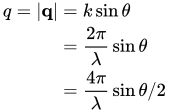
The length of this vector is:
Theory
The mathematical form of scattering is closely related to the Fourier transform. The sample's realspace density distribution is Fourier transformed into an abstract 3D reciprocal-space; scattering probes this inverse space. The fundamental equation in scattering is:
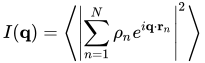
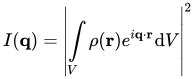
Where the observed scattering intensity (I) in the 3D reciprocal-space (q) is given by an ensemble average of the intensity for all (N) scattering entities probed by the beam. The wave-matter interaction is given by inner term, which coherently sums (interferes) the complex scattering contributions ( denotes the scattering power) of the N entities; the exponential term represents a plane wave (incident radiation). In integral form (for a continuous function of the scattering density ), we can write an integral over all of real-space:


The inner component can be thought of as the reciprocal-space:
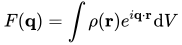
This is mathematically identical to the (three-dimensional) Fourier transform.

