Scattering

Scattering broadly refers to experimental techniques that use the interaction between radiation and matter to elucidate structure. In x-ray scattering, a collimated x-ray beam is directed at a sample of interest. The incident x-rays scatter off of all the atoms/particles in the sample. Because of the wavelike nature of x-rays (which are simply high-energy photons; i.e. electromagnetic rays), the scattered waves interfere with one another, leading to constructive interference at some angles, but destructive interference at other angles. The end result is a pattern of scattered radiation (as a function of angle with respect to the direct beam) that encodes the microscopic, nanoscopic, and molecular-scale structure of the sample.
Contents
Geometry
TSAXS 1D
We define a vector in reciprocal-space as the difference between the incident and scattered x-ray beams. This new vector is the momentum transfer, denoted by q:

The length of this vector is:
- Failed to parse (MathML with SVG or PNG fallback (recommended for modern browsers and accessibility tools): Invalid response ("Math extension cannot connect to Restbase.") from server "https://wikimedia.org/api/rest_v1/":): {\displaystyle \begin{alignat}{2} q = |\mathbf{q}| & = k \sin { ( \theta /2 ) } \\ & = \frac{2 \pi}{\lambda} \sin{ ( \theta /2 ) } \\ & = \frac{4 \pi}{\lambda} \sin{ \theta} \end{alignat} }
Where is the scattering angle.

TSAXS 3D
The q-vector in fact has three components:

Consider that the x-ray beam points along +y, so that on the detector, the horizontal is x, and the vertical is z. We assume that the x-ray beam hits the flat 2D area detector at 90° at detector (pixel) position Failed to parse (MathML with SVG or PNG fallback (recommended for modern browsers and accessibility tools): Invalid response ("Math extension cannot connect to Restbase.") from server "https://wikimedia.org/api/rest_v1/":): {\displaystyle \scriptstyle (x,z) } . The scattering angles are then:
- Failed to parse (MathML with SVG or PNG fallback (recommended for modern browsers and accessibility tools): Invalid response ("Math extension cannot connect to Restbase.") from server "https://wikimedia.org/api/rest_v1/":): {\displaystyle \begin{alignat}{2} \theta_f & = \arctan( x/d ) \\ \alpha_f & = \arctan( z/d ) \end{alignat} }
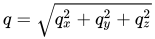
where Failed to parse (MathML with SVG or PNG fallback (recommended for modern browsers and accessibility tools): Invalid response ("Math extension cannot connect to Restbase.") from server "https://wikimedia.org/api/rest_v1/":): {\displaystyle \scriptstyle d} is the sample-detector distance, is the out-of-plane component (angle w.r.t. to y-axis, rotation about x-axis), and is the in-plane component (rotation about z-axis). The total scattering angle is related via:


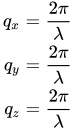
And, of course:
Theory
The mathematical form of scattering is closely related to the Fourier transform. The sample's realspace density distribution is Fourier transformed into an abstract 3D reciprocal-space; scattering probes this inverse space. The fundamental equation in scattering is:
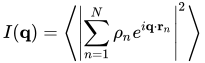
Where the observed scattering intensity (I) in the 3D reciprocal-space (q) is given by an ensemble average of the intensity for all (N) scattering entities probed by the beam. The wave-matter interaction is given by inner term, which coherently sums (interferes) the complex scattering contributions ( denotes the scattering power) of the N entities; the exponential term represents a plane wave (incident radiation). In integral form (for a continuous function of the scattering density ), we can write an integral over all of real-space:


- Failed to parse (MathML with SVG or PNG fallback (recommended for modern browsers and accessibility tools): Invalid response ("Math extension cannot connect to Restbase.") from server "https://wikimedia.org/api/rest_v1/":): {\displaystyle \begin{alignat}{2} I(\mathbf{q}) & = \left| \int\limits_{V} \rho(\mathbf{r}) e^{i \mathbf{q} \cdot \mathbf{r} } \mathrm{d}V \right|^2 \\ \end{alignat} }
The inner component can be thought of as the reciprocal-space:
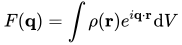
This is mathematically identical to the (three-dimensional) Fourier transform.

