Unit cell
The unit cell is the basic building block of a crystal lattice (whether an atomic crystal or a nanoscale superlattice). Crystalline materials have a periodic structure, with the unit cell being the minimal volume necessary to fully describe the repeating structure. There are a finite number of possible symmetries for the repeating unit cell.
A unit cell can be defined by three vectors that lie along the edges of the enclosing parallelepped. We denote the vectors as Failed to parse (MathML with SVG or PNG fallback (recommended for modern browsers and accessibility tools): Invalid response ("Math extension cannot connect to Restbase.") from server "https://wikimedia.org/api/rest_v1/":): {\displaystyle \mathbf{a}} , Failed to parse (MathML with SVG or PNG fallback (recommended for modern browsers and accessibility tools): Invalid response ("Math extension cannot connect to Restbase.") from server "https://wikimedia.org/api/rest_v1/":): {\displaystyle \mathbf{b}} , and Failed to parse (MathML with SVG or PNG fallback (recommended for modern browsers and accessibility tools): Invalid response ("Math extension cannot connect to Restbase.") from server "https://wikimedia.org/api/rest_v1/":): {\displaystyle \mathbf{c}} ; alternately the unit cell can be described by the lengths of these vectors (Failed to parse (MathML with SVG or PNG fallback (recommended for modern browsers and accessibility tools): Invalid response ("Math extension cannot connect to Restbase.") from server "https://wikimedia.org/api/rest_v1/":): {\displaystyle a} , Failed to parse (MathML with SVG or PNG fallback (recommended for modern browsers and accessibility tools): Invalid response ("Math extension cannot connect to Restbase.") from server "https://wikimedia.org/api/rest_v1/":): {\displaystyle b} , Failed to parse (MathML with SVG or PNG fallback (recommended for modern browsers and accessibility tools): Invalid response ("Math extension cannot connect to Restbase.") from server "https://wikimedia.org/api/rest_v1/":): {\displaystyle c} ), and the angles between them:
- Failed to parse (MathML with SVG or PNG fallback (recommended for modern browsers and accessibility tools): Invalid response ("Math extension cannot connect to Restbase.") from server "https://wikimedia.org/api/rest_v1/":): {\displaystyle \alpha} , the angle between Failed to parse (MathML with SVG or PNG fallback (recommended for modern browsers and accessibility tools): Invalid response ("Math extension cannot connect to Restbase.") from server "https://wikimedia.org/api/rest_v1/":): {\displaystyle b} and Failed to parse (MathML with SVG or PNG fallback (recommended for modern browsers and accessibility tools): Invalid response ("Math extension cannot connect to Restbase.") from server "https://wikimedia.org/api/rest_v1/":): {\displaystyle c}
- Failed to parse (MathML with SVG or PNG fallback (recommended for modern browsers and accessibility tools): Invalid response ("Math extension cannot connect to Restbase.") from server "https://wikimedia.org/api/rest_v1/":): {\displaystyle \beta} , the angle between Failed to parse (MathML with SVG or PNG fallback (recommended for modern browsers and accessibility tools): Invalid response ("Math extension cannot connect to Restbase.") from server "https://wikimedia.org/api/rest_v1/":): {\displaystyle a} and Failed to parse (MathML with SVG or PNG fallback (recommended for modern browsers and accessibility tools): Invalid response ("Math extension cannot connect to Restbase.") from server "https://wikimedia.org/api/rest_v1/":): {\displaystyle c}
- Failed to parse (MathML with SVG or PNG fallback (recommended for modern browsers and accessibility tools): Invalid response ("Math extension cannot connect to Restbase.") from server "https://wikimedia.org/api/rest_v1/":): {\displaystyle \gamma} , the angle between Failed to parse (MathML with SVG or PNG fallback (recommended for modern browsers and accessibility tools): Invalid response ("Math extension cannot connect to Restbase.") from server "https://wikimedia.org/api/rest_v1/":): {\displaystyle a} and Failed to parse (MathML with SVG or PNG fallback (recommended for modern browsers and accessibility tools): Invalid response ("Math extension cannot connect to Restbase.") from server "https://wikimedia.org/api/rest_v1/":): {\displaystyle b}
Contents
Mathematical description
Vectors
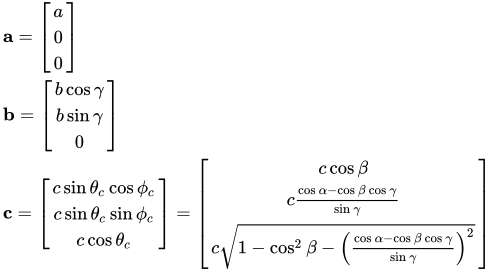
Relations



Volume

If a, b, and c are the parallelepiped edge lengths, and α, β, and γ are the internal angles between the edges, the volume is

The volume of a unit cell with all edge-length equal to unity is:

Angles
- is the angle between and
- is the angle between and
- is the angle between and


Reciprocal vectors
The repeating structure of a unit cell creates peaks in reciprocal space. In particular, we observe maxima (constructive interference) when:

Where , , and are integers. We define reciprocal-space vectors:


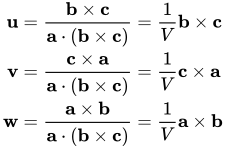
And we can then express the momentum transfer () in terms of these reciprocal vectors:


Combining with the three Laue equations yields:
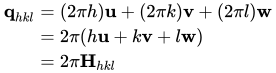
Where is a vector that defines the position of Bragg reflection for the reciprocal-lattice.


Examples
Cubic
Since , , and:


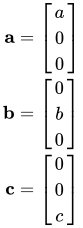
And in reciprocal-space:
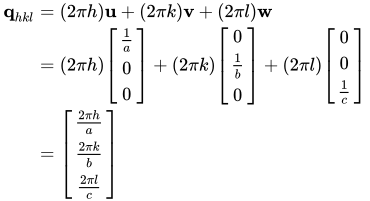
- Failed to parse (MathML with SVG or PNG fallback (recommended for modern browsers and accessibility tools): Invalid response ("Math extension cannot connect to Restbase.") from server "https://wikimedia.org/api/rest_v1/":): {\displaystyle \begin{alignat}{2} \mathbf{u} & =\frac{1}{V} \mathbf{b}\times\mathbf{c} & =\frac{1}{V} \begin{bmatrix} b c \\ 0 \\ 0 \end{bmatrix} & = \begin{bmatrix} \frac{1}{a} \\ 0 \\ 0 \end{bmatrix}\\ \mathbf{v} & =\frac{1}{V} \mathbf{c}\times\mathbf{a} & =\frac{1}{V} \begin{bmatrix} 0 \\ a c \\ 0 \end{bmatrix} & = \begin{bmatrix} 0 \\ \frac{1}{b} \\ 0 \end{bmatrix}\\ \mathbf{w} & =\frac{1}{V} \mathbf{a}\times\mathbf{b} & =\frac{1}{V} \begin{bmatrix} 0 \\ 0 \\ a b \end{bmatrix} & = \begin{bmatrix} 0 \\ 0 \\ \frac{1}{c} \end{bmatrix}\\ \end{alignat} }
So:
Hexagonal
Since Failed to parse (MathML with SVG or PNG fallback (recommended for modern browsers and accessibility tools): Invalid response ("Math extension cannot connect to Restbase.") from server "https://wikimedia.org/api/rest_v1/":): {\displaystyle \alpha=\beta=90^{\circ}} and , , and:


- Failed to parse (MathML with SVG or PNG fallback (recommended for modern browsers and accessibility tools): Invalid response ("Math extension cannot connect to Restbase.") from server "https://wikimedia.org/api/rest_v1/":): {\displaystyle \begin{alignat}{2} \mathbf{a} & = \begin{bmatrix} a \\ 0 \\ 0 \end{bmatrix} \\ \mathbf{b} & = \begin{bmatrix} \frac{1}{2}b \\ \frac{\sqrt{3}}{2} b \\ 0 \end{bmatrix} \\ \mathbf{c} & = \begin{bmatrix} 0 \\ 0 \\ c \end{bmatrix} \\ \end{alignat} }
And in reciprocal-space:
- Failed to parse (MathML with SVG or PNG fallback (recommended for modern browsers and accessibility tools): Invalid response ("Math extension cannot connect to Restbase.") from server "https://wikimedia.org/api/rest_v1/":): {\displaystyle \begin{alignat}{2} \mathbf{u} & =\frac{1}{V} \mathbf{b}\times\mathbf{c} & =\frac{1}{V} \begin{bmatrix} \frac{\sqrt{3}}{2} b c \\ -\frac{1}{2} b c \\ 0 \end{bmatrix} & = \begin{bmatrix} \frac{1}{a} \\ \frac{1}{\sqrt{3}a} \\ 0 \end{bmatrix}\\ \mathbf{v} & =\frac{1}{V} \mathbf{c}\times\mathbf{a} & =\frac{1}{V} \begin{bmatrix} 0 \\ a c \\ 0 \end{bmatrix} & = \begin{bmatrix} 0 \\ \frac{2}{\sqrt{3}b} \\ 0 \end{bmatrix}\\ \mathbf{w} & =\frac{1}{V} \mathbf{a}\times\mathbf{b} & =\frac{1}{V} \begin{bmatrix} 0 \\ 0 \\ \frac{\sqrt{3}}{2} a b \end{bmatrix} & = \begin{bmatrix} 0 \\ 0 \\ \frac{1}{c} \end{bmatrix}\\ \end{alignat} }
So:
- Failed to parse (MathML with SVG or PNG fallback (recommended for modern browsers and accessibility tools): Invalid response ("Math extension cannot connect to Restbase.") from server "https://wikimedia.org/api/rest_v1/":): {\displaystyle \begin{alignat}{2} \mathbf{q}_{hkl} & = (2 \pi h)\mathbf{u} + (2 \pi k)\mathbf{v} + (2 \pi l)\mathbf{w} \\ & = (2 \pi h)\begin{bmatrix} \frac{1}{a} \\ \frac{1}{\sqrt{3}a} \\ 0 \end{bmatrix} + (2 \pi k)\begin{bmatrix} 0 \\ \frac{2}{\sqrt{3}b} \\ 0 \end{bmatrix} + (2 \pi l)\begin{bmatrix} 0 \\ 0 \\ \frac{1}{c} \end{bmatrix} \\ & = \begin{bmatrix} \frac{2 \pi h}{a} \\ \frac{2 \pi h}{\sqrt{3}a} + \frac{4 \pi k}{\sqrt{3}b} \\ \frac{2 \pi l}{c} \end{bmatrix} \\ & = \begin{bmatrix} \frac{2 \pi h}{a} \\ \frac{2 \pi (h + 2 k)}{\sqrt{3}a} \\ \frac{2 \pi l}{c} \end{bmatrix} \end{alignat} }

