Paper:DNA-nanoparticle superlattices formed from anisotropic building blocks
Revision as of 15:21, 3 December 2014 by KevinYager (talk | contribs)
This is a summary/discussion of the results from:
- Matthew R. Jones, Robert J. Macfarlane, Byeongdu Lee, Jian Zhang, Kaylie L. Young, Andrew J. Senesi, and Chad A. Mirkin DNA-nanoparticle superlattices formed from anisotropic building blocks Nature Materials 2010, 9, 913-917 doi: 10.1038/nmat2870
This paper describes the formation of nanoparticle superlattices from anisotropic nano-objects. In the Supplementary Information information, the authors describe how to model x-ray scattering data from lattices of anisotropic nanoparticles.
Summary of Mathematics
Randomly oriented crystals give scattering intensity:
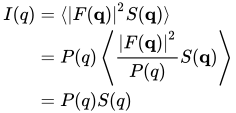
Where the structure factor is defined by an orientational average (randomly oriented crystal(s)):

and can be computed by:
- Failed to parse (MathML with SVG or PNG fallback (recommended for modern browsers and accessibility tools): Invalid response ("Math extension cannot connect to Restbase.") from server "https://wikimedia.org/api/rest_v1/":): {\displaystyle S(q) = \frac{c}{ q_{hkl}^2P(q_{hkl}) } \sum_{ \{hkl\} }^{m_{hkl} } \left|F(M \cdot \mathbf{q}_{hkl}) \sum_{i=1}^{n_c} e^{2\pi i(x_ih+y_ik+z_il)} \right|^2 e^{-\sigma_D^2q_{hkl}^2a^2} L_{hkl}(q-q_{hkl}) }
Where c is a constant, and L is the peak shape; such as:

The (isotropic) form factor intensity is an average over all possible particle orientations:
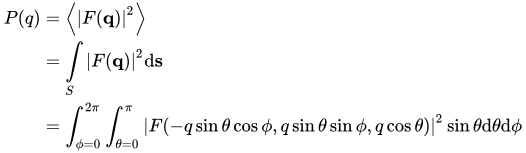
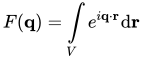
The form factor amplitude is computed via:
Form Factors
The SI also provides form factors for a variety of nano-object shapes:
- Pyramid
- Cube
- Cylinder
- Octahedron
- Rhombic dodecahedron (RD)
- Triangular prism

