Extra:Hexagonal peaks
Revision as of 15:26, 27 July 2018 by KevinYager (talk | contribs) (Created page with "Consider a hexagonal lattice viewed end-on using scattering. For instance, hexgaonally-packed-cylinder block-copolymer moprhology that is oriente...")
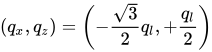
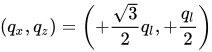
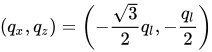
Consider a hexagonal lattice viewed end-on using scattering. For instance, hexgaonally-packed-cylinder block-copolymer moprhology that is oriented horizontally ('laying down'; i.e. cylinder long axes parallel to the substrate plane). There will be a peak along the specular at , where corresponds to the cylinder layering distance in realspace (i.e. the distance between subsequent rows of cylinders). The full set of peaks is:


- and
- and Failed to parse (MathML with SVG or PNG fallback (recommended for modern browsers and accessibility tools): Invalid response ("Math extension cannot connect to Restbase.") from server "https://wikimedia.org/api/rest_v1/":): {\displaystyle (q_x, q_z) = \left ( +\frac{\sqrt{3}}{2} q_l, -\frac{q_l}{2} \right )}
- Failed to parse (MathML with SVG or PNG fallback (recommended for modern browsers and accessibility tools): Invalid response ("Math extension cannot connect to Restbase.") from server "https://wikimedia.org/api/rest_v1/":): {\displaystyle (q_x, q_z) = (0, -q_l)}

Since:
- Failed to parse (MathML with SVG or PNG fallback (recommended for modern browsers and accessibility tools): Invalid response ("Math extension cannot connect to Restbase.") from server "https://wikimedia.org/api/rest_v1/":): {\displaystyle \cos 30^{\circ} = \frac{\sqrt{3}}{2}}

The realspace layering distance is:

And the realspace cylinder-cylinder distance is:


