Form Factor:Ellipsoid of revolution
An ellipsoid of revolution is a 'squashed' or 'stretched' sphere; technically an oblate or prolate spheroid, respectively.
Contents
Equations
For an ellipsoid of revolution, the size ('radius') along one direction will be distinct, whereas the other two directions will be identical. Assume an ellipsoid aligned along the z-direction (rotation about z-axis, i.e. sweeping the angle in spherical coordinates), such that the size in the xy-plane is Failed to parse (Conversion error. Server ("https://wikimedia.org/api/rest_") reported: "Cannot get mml. Server problem."): {\displaystyle R_{r}} and along z is . A useful quantity is , which is the distance from the origin to the surface of the ellipsoid for a line titled at angle with respect to the z-axis. This is thus the half-distance between tangent planes orthogonal to a vector pointing at the given angle, and provides the 'effective size' of the scattering object as seen by a q-vector pointing in that direction.


The ellipsoid is also characterized by:

Form Factor Amplitude

Isotropic Form Factor Intensity
- Failed to parse (Conversion error. Server ("https://wikimedia.org/api/rest_") reported: "Cannot get mml. Server problem."): {\displaystyle P_{ell}(q)=\left\{{\begin{array}{c l}18\pi \Delta \rho ^{2}V_{ell}^{2}\int _{0}^{\pi }\left({\frac {\sin(qR_{\theta })-qR_{\theta }\cos(qR_{\theta })}{(qR_{\theta })^{3}}}\right)^{2}\sin \theta \mathrm {d} \theta &\mathrm {when} \,\,q\neq 0\\4\pi \Delta \rho ^{2}V_{ell}^{2}&\mathrm {when} \,\,q=0\\\end{array}}\right.}
Sources
NCNR
From NCNR SANS Models documentation:
- Failed to parse (MathML with SVG or PNG fallback (recommended for modern browsers and accessibility tools): Invalid response ("Math extension cannot connect to Restbase.") from server "https://wikimedia.org/api/rest_v1/":): {\displaystyle \begin{alignat}{2} P(q) & =\frac{ \rm{scale} }{ V_{ell} }(\rho_{ell}-\rho_{solv})^2 \int_0^1 f^2 [ qr_b(1+x^2(v^2-1))^{1/2} ] dx + bkg \\ f(z) & = 3 V_{ell} \frac{(\sin z - z \cos z)}{z^3} \\ V_{ell} & = \frac{4 \pi}{3} r_a r_b^2 \\ v & = \frac{r_a}{r_b} \\ \end{alignat} }
- Parameters:
- : Intensity scaling
- Failed to parse (MathML with SVG or PNG fallback (recommended for modern browsers and accessibility tools): Invalid response ("Math extension cannot connect to Restbase.") from server "https://wikimedia.org/api/rest_v1/":): {\displaystyle r_a} : rotation axis (Å)
- Failed to parse (MathML with SVG or PNG fallback (recommended for modern browsers and accessibility tools): Invalid response ("Math extension cannot connect to Restbase.") from server "https://wikimedia.org/api/rest_v1/":): {\displaystyle r_b} : orthogonal axis (Å)
- Failed to parse (MathML with SVG or PNG fallback (recommended for modern browsers and accessibility tools): Invalid response ("Math extension cannot connect to Restbase.") from server "https://wikimedia.org/api/rest_v1/":): {\displaystyle \rho_{ell}-\rho_{solv}} : scattering contrast (Å−2)
- Failed to parse (MathML with SVG or PNG fallback (recommended for modern browsers and accessibility tools): Invalid response ("Math extension cannot connect to Restbase.") from server "https://wikimedia.org/api/rest_v1/":): {\displaystyle \rm{background}} : incoherent background (cm−1)

Pedersen
From Pedersen review, Analysis of small-angle scattering data from colloids and polymer solutions: modeling and least-squares fitting Jan Skov Pedersen, Advances in Colloid and Interface Science 1997, 70, 171. doi: 10.1016/S0001-8686(97)00312-6
- Failed to parse (MathML with SVG or PNG fallback (recommended for modern browsers and accessibility tools): Invalid response ("Math extension cannot connect to Restbase.") from server "https://wikimedia.org/api/rest_v1/":): {\displaystyle \begin{alignat}{2} & P(q, R, \epsilon)= \int_{0}^{\pi / 2} F_{sphere}^2[q,r(R,\epsilon,\alpha)] \sin \alpha d\alpha \\ & r(R,\epsilon,\alpha) = R \left( \sin^2\alpha + \epsilon^2 \cos^2 \alpha \right)^{1/2} \end{alignat} }
Where:
- Failed to parse (MathML with SVG or PNG fallback (recommended for modern browsers and accessibility tools): Invalid response ("Math extension cannot connect to Restbase.") from server "https://wikimedia.org/api/rest_v1/":): {\displaystyle F_{sphere} = \frac{ 3 \left[ \sin(qr)-qr \cos(qr) \right ] }{ (qr)^3 } }
- Parameters:
- Failed to parse (MathML with SVG or PNG fallback (recommended for modern browsers and accessibility tools): Invalid response ("Math extension cannot connect to Restbase.") from server "https://wikimedia.org/api/rest_v1/":): {\displaystyle R} : radius (Å)
- Failed to parse (MathML with SVG or PNG fallback (recommended for modern browsers and accessibility tools): Invalid response ("Math extension cannot connect to Restbase.") from server "https://wikimedia.org/api/rest_v1/":): {\displaystyle \epsilon R} : orthogonal size (Å)
IsGISAXS
From IsGISAXS, Born form factors:
- Failed to parse (MathML with SVG or PNG fallback (recommended for modern browsers and accessibility tools): Invalid response ("Math extension cannot connect to Restbase.") from server "https://wikimedia.org/api/rest_v1/":): {\displaystyle F_{ell}(\mathbf{q}, R, W, H, \alpha) = 2 \pi RWH \frac{ J_1 (\gamma) }{ \gamma } \sin_c(q_z H/2) \exp( i q_z H/2 )}
- Failed to parse (MathML with SVG or PNG fallback (recommended for modern browsers and accessibility tools): Invalid response ("Math extension cannot connect to Restbase.") from server "https://wikimedia.org/api/rest_v1/":): {\displaystyle \gamma = \sqrt{ (q_x R)^2 + (q_y W)^2 } }
- Failed to parse (MathML with SVG or PNG fallback (recommended for modern browsers and accessibility tools): Invalid response ("Math extension cannot connect to Restbase.") from server "https://wikimedia.org/api/rest_v1/":): {\displaystyle V_{ell} = \pi RWH, \, S_{anpy} = \pi R W , \, R_{anpy} = Max(R,W) }
Where (presumably) J is a Bessel function:
- Failed to parse (MathML with SVG or PNG fallback (recommended for modern browsers and accessibility tools): Invalid response ("Math extension cannot connect to Restbase.") from server "https://wikimedia.org/api/rest_v1/":): {\displaystyle J_1(\gamma) = \frac{1}{\pi} \int_0^\pi \cos (\tau - x \sin \tau) \,\mathrm{d}\tau }
Sjoberg Monte Carlo Study
From Small-angle scattering from collections of interacting hard ellipsoids of revolution studied by Monte Carlo simulations and other methods of statistical thermodynamics, Bo Sjöberg, J.Appl. Cryst. (1999), 32, 917-923. doi 10.1107/S0021889899006640
- Failed to parse (MathML with SVG or PNG fallback (recommended for modern browsers and accessibility tools): Invalid response ("Math extension cannot connect to Restbase.") from server "https://wikimedia.org/api/rest_v1/":): {\displaystyle F(\mathbf{q}) = 3 \frac{ \sin(qs) - qs \cos(qs) }{(qs)^3} }
where:
- Failed to parse (MathML with SVG or PNG fallback (recommended for modern browsers and accessibility tools): Invalid response ("Math extension cannot connect to Restbase.") from server "https://wikimedia.org/api/rest_v1/":): {\displaystyle s=\left[ a^2\cos^2\gamma + b^2(1-\cos^2\gamma) \right]^{1/2} }
where Failed to parse (MathML with SVG or PNG fallback (recommended for modern browsers and accessibility tools): Invalid response ("Math extension cannot connect to Restbase.") from server "https://wikimedia.org/api/rest_v1/":): {\displaystyle \gamma} is the angle between Failed to parse (MathML with SVG or PNG fallback (recommended for modern browsers and accessibility tools): Invalid response ("Math extension cannot connect to Restbase.") from server "https://wikimedia.org/api/rest_v1/":): {\displaystyle \mathbf{q}} and the a-axis vector of the ellipsoid of revolution (which also has axes b = c); Failed to parse (MathML with SVG or PNG fallback (recommended for modern browsers and accessibility tools): Invalid response ("Math extension cannot connect to Restbase.") from server "https://wikimedia.org/api/rest_v1/":): {\displaystyle \cos\gamma} is the inner product of unit vectors parallel to Failed to parse (MathML with SVG or PNG fallback (recommended for modern browsers and accessibility tools): Invalid response ("Math extension cannot connect to Restbase.") from server "https://wikimedia.org/api/rest_v1/":): {\displaystyle \mathbf{q}} and the a-axis. In some sense, s is the 'equivalent size' of a sphere that would lead to the scattering for a particular Failed to parse (MathML with SVG or PNG fallback (recommended for modern browsers and accessibility tools): Invalid response ("Math extension cannot connect to Restbase.") from server "https://wikimedia.org/api/rest_v1/":): {\displaystyle \mathbf{q}} : it is half the distance between the tangential planes that bound the ellipsoid, perpendicular to the Failed to parse (MathML with SVG or PNG fallback (recommended for modern browsers and accessibility tools): Invalid response ("Math extension cannot connect to Restbase.") from server "https://wikimedia.org/api/rest_v1/":): {\displaystyle \mathbf{q}} -vector.
Note that for Failed to parse (MathML with SVG or PNG fallback (recommended for modern browsers and accessibility tools): Invalid response ("Math extension cannot connect to Restbase.") from server "https://wikimedia.org/api/rest_v1/":): {\displaystyle a = \epsilon b} :
- Failed to parse (MathML with SVG or PNG fallback (recommended for modern browsers and accessibility tools): Invalid response ("Math extension cannot connect to Restbase.") from server "https://wikimedia.org/api/rest_v1/":): {\displaystyle \begin{alignat}{2} s & = \left[ a^2\cos^2\gamma + b^2(1-\cos^2\gamma) \right]^{1/2} \\ & = \left[ b^2\epsilon^2\cos^2\gamma + b^2(1-\cos^2\gamma) \right]^{1/2} \\ & = b \left[ \epsilon^2\cos^2\gamma + (1-\cos^2\gamma) \right]^{1/2} \\ & = b \left[ \epsilon^2\cos^2\gamma + \sin^2\gamma \right]^{1/2} \\ & = b \left[ 1 + (\epsilon^2-1)\cos^2\gamma \right]^{1/2} \end{alignat} }
Derivations
Form Factor
For an ellipsoid oriented along the z-axis, we denote the size in-plane (in x and y) as Failed to parse (MathML with SVG or PNG fallback (recommended for modern browsers and accessibility tools): Invalid response ("Math extension cannot connect to Restbase.") from server "https://wikimedia.org/api/rest_v1/":): {\displaystyle R_r} and the size along z as Failed to parse (MathML with SVG or PNG fallback (recommended for modern browsers and accessibility tools): Invalid response ("Math extension cannot connect to Restbase.") from server "https://wikimedia.org/api/rest_v1/":): {\displaystyle R_z=\epsilon R_r} . The parameter Failed to parse (MathML with SVG or PNG fallback (recommended for modern browsers and accessibility tools): Invalid response ("Math extension cannot connect to Restbase.") from server "https://wikimedia.org/api/rest_v1/":): {\displaystyle \epsilon} denotes the shape of the ellipsoid: Failed to parse (MathML with SVG or PNG fallback (recommended for modern browsers and accessibility tools): Invalid response ("Math extension cannot connect to Restbase.") from server "https://wikimedia.org/api/rest_v1/":): {\displaystyle \epsilon=1} for a sphere, Failed to parse (MathML with SVG or PNG fallback (recommended for modern browsers and accessibility tools): Invalid response ("Math extension cannot connect to Restbase.") from server "https://wikimedia.org/api/rest_v1/":): {\displaystyle \epsilon<1} for an oblate spheroid and Failed to parse (MathML with SVG or PNG fallback (recommended for modern browsers and accessibility tools): Invalid response ("Math extension cannot connect to Restbase.") from server "https://wikimedia.org/api/rest_v1/":): {\displaystyle \epsilon>1} for a prolate spheroid. The volume is thus:
- Failed to parse (MathML with SVG or PNG fallback (recommended for modern browsers and accessibility tools): Invalid response ("Math extension cannot connect to Restbase.") from server "https://wikimedia.org/api/rest_v1/":): {\displaystyle V_{ell} = \frac{ 4\pi }{ 3 } R_z R_r^2 = \frac{ 4\pi }{ 3 } \epsilon R_r^3 }
We also note that the cross-section of the ellipsoid (an ellipse) will have coordinates Failed to parse (MathML with SVG or PNG fallback (recommended for modern browsers and accessibility tools): Invalid response ("Math extension cannot connect to Restbase.") from server "https://wikimedia.org/api/rest_v1/":): {\displaystyle (r_{xy},z)} (where Failed to parse (MathML with SVG or PNG fallback (recommended for modern browsers and accessibility tools): Invalid response ("Math extension cannot connect to Restbase.") from server "https://wikimedia.org/api/rest_v1/":): {\displaystyle r_{xy}} is a distance in the xy-plane):
- Failed to parse (MathML with SVG or PNG fallback (recommended for modern browsers and accessibility tools): Invalid response ("Math extension cannot connect to Restbase.") from server "https://wikimedia.org/api/rest_v1/":): {\displaystyle \begin{alignat}{2} r_{xy} & = R_r \sin\theta \\ z & = R_z \cos\theta = \epsilon R_r \cos\theta \end{alignat} }
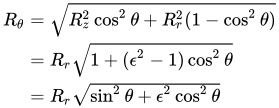
Where Failed to parse (MathML with SVG or PNG fallback (recommended for modern browsers and accessibility tools): Invalid response ("Math extension cannot connect to Restbase.") from server "https://wikimedia.org/api/rest_v1/":): {\displaystyle \theta} is the angle with the z-axis. This lets us define a useful quantity, Failed to parse (MathML with SVG or PNG fallback (recommended for modern browsers and accessibility tools): Invalid response ("Math extension cannot connect to Restbase.") from server "https://wikimedia.org/api/rest_v1/":): {\displaystyle R_{\theta}} , which is the distance to the point from the origin:
- Failed to parse (MathML with SVG or PNG fallback (recommended for modern browsers and accessibility tools): Invalid response ("Math extension cannot connect to Restbase.") from server "https://wikimedia.org/api/rest_v1/":): {\displaystyle \begin{alignat}{2} R_{\theta} & = \sqrt{ (R_r \sin\theta)^2 + (R_z \cos \theta)^2 } \\ & = \sqrt{ R_r^2 \sin^2\theta + \epsilon^2 R_r^2 \cos^2 \theta } \\ & = R_r \sqrt{ \sin^2\theta + \epsilon^2 \cos^2 \theta } \\ \end{alignat} }
The form factor is:
- Failed to parse (MathML with SVG or PNG fallback (recommended for modern browsers and accessibility tools): Invalid response ("Math extension cannot connect to Restbase.") from server "https://wikimedia.org/api/rest_v1/":): {\displaystyle \begin{alignat}{2} F_{ell}(\mathbf{q}) & = \int\limits_V e^{i \mathbf{q} \cdot \mathbf{r} } \mathrm{d}\mathbf{r} \\ & = \int_{\phi=0}^{2\pi}\int_{\theta=0}^{\pi}\int_{r=0}^{R_{\theta}} e^{i \mathbf{q} \cdot \mathbf{r} } r^2 \mathrm{d}r \sin\theta \mathrm{d}\theta \mathrm{d}\phi \\ & = 2 \pi \int_{0}^{\pi} \left [ \int_{0}^{R_{\theta}} e^{i \mathbf{q} \cdot \mathbf{r} } r^2 \mathrm{d}r \right ] \sin\theta \mathrm{d}\theta \\ \end{alignat}}
Imagine instead that we compress/stretch the z dimension so that the ellipsoid becomes a sphere:
- Failed to parse (MathML with SVG or PNG fallback (recommended for modern browsers and accessibility tools): Invalid response ("Math extension cannot connect to Restbase.") from server "https://wikimedia.org/api/rest_v1/":): {\displaystyle \begin{alignat}{2} x^{\prime} & = x \\ y^{\prime} & = y \\ z^{\prime} & = z R_r/R_z=z/\epsilon \\ r^{\prime} & = \left| \mathbf{r}^{\prime} \right| = r \frac{R_r}{R_{\gamma}} \\ \mathrm{d}V & = \mathrm{d}x\mathrm{d}y\mathrm{d}z = \mathrm{d}x^{\prime}\mathrm{d}y^{\prime}\epsilon\mathrm{d}z^{\prime} = \epsilon \mathrm{d}V^{\prime} \end{alignat} }
This implies a coordinate transformation for the Failed to parse (MathML with SVG or PNG fallback (recommended for modern browsers and accessibility tools): Invalid response ("Math extension cannot connect to Restbase.") from server "https://wikimedia.org/api/rest_v1/":): {\displaystyle \mathbf{q}} -vector of:
- Failed to parse (MathML with SVG or PNG fallback (recommended for modern browsers and accessibility tools): Invalid response ("Math extension cannot connect to Restbase.") from server "https://wikimedia.org/api/rest_v1/":): {\displaystyle \begin{alignat}{2} q_x^{\prime} & = q_x \\ q_y^{\prime} & = q_y \\ q_z^{\prime} & = q_z R_z/R_r = q_z \epsilon \\ q^{\prime} & = \left| \mathbf{q}^{\prime} \right| = q \frac{R_{\gamma}}{R_r} \end{alignat} }
Where Failed to parse (MathML with SVG or PNG fallback (recommended for modern browsers and accessibility tools): Invalid response ("Math extension cannot connect to Restbase.") from server "https://wikimedia.org/api/rest_v1/":): {\displaystyle R_{\gamma}} is the Failed to parse (MathML with SVG or PNG fallback (recommended for modern browsers and accessibility tools): Invalid response ("Math extension cannot connect to Restbase.") from server "https://wikimedia.org/api/rest_v1/":): {\displaystyle R_{\theta}} relation for a q-vector tilted at angle Failed to parse (MathML with SVG or PNG fallback (recommended for modern browsers and accessibility tools): Invalid response ("Math extension cannot connect to Restbase.") from server "https://wikimedia.org/api/rest_v1/":): {\displaystyle \gamma} with respect to the z axis. Considered in this way, the integral reduces to the form factor for a sphere. In effect, a particular Failed to parse (MathML with SVG or PNG fallback (recommended for modern browsers and accessibility tools): Invalid response ("Math extension cannot connect to Restbase.") from server "https://wikimedia.org/api/rest_v1/":): {\displaystyle \mathbf{q}} vector sees a sphere-like scatterer with size (length-scale) given by Failed to parse (MathML with SVG or PNG fallback (recommended for modern browsers and accessibility tools): Invalid response ("Math extension cannot connect to Restbase.") from server "https://wikimedia.org/api/rest_v1/":): {\displaystyle R_{\gamma}} .
- Failed to parse (MathML with SVG or PNG fallback (recommended for modern browsers and accessibility tools): Invalid response ("Math extension cannot connect to Restbase.") from server "https://wikimedia.org/api/rest_v1/":): {\displaystyle \begin{alignat}{2} F_{ell}(\mathbf{q}) & = \epsilon \int_{\phi=0}^{2\pi}\int_{\theta=0}^{\pi}\int_{r^{\prime}=0}^{R_r} e^{i \mathbf{q}^{\prime} \cdot \mathbf{r}^{\prime} } r^{\prime 2} \mathrm{d}r^{\prime} \sin\theta \mathrm{d}\theta \mathrm{d}\phi \\ & = 3 \left( \frac{4 \pi}{3} \epsilon R_r^3 \right) \frac{ \sin(q^{\prime} R_r) - q^{\prime} R_r \cos(q^{\prime} R_r) }{ (q^{\prime} R_r)^3 } \end{alignat}}
We can then convert back:

Isotropic Form Factor Intensity
To average over all possible orientations, we use:
- Failed to parse (MathML with SVG or PNG fallback (recommended for modern browsers and accessibility tools): Invalid response ("Math extension cannot connect to Restbase.") from server "https://wikimedia.org/api/rest_v1/":): {\displaystyle \begin{alignat}{2} P_{ell}(q) & = \int_{\phi=0}^{2\pi}\int_{\theta=0}^{\pi} | F_{ell}(\mathbf{q}) |^2 \sin\theta\mathrm{d}\theta\mathrm{d}\phi \\ & = \int_{0}^{2\pi}\int_{0}^{\pi} \left| 3 V_{ell} \frac{ \sin(q R_{\theta}) - q R_{\theta} \cos(q R_{\theta}) }{ (q R_{\theta})^3 } \right|^2 \sin\theta\mathrm{d}\theta\mathrm{d}\phi \\ & = 9 V_{ell}^2 \int_{0}^{2\pi}\mathrm{d}\phi \int_{0}^{\pi} \left( \frac{ \sin(q R_{\theta}) - q R_{\theta} \cos(q R_{\theta}) }{ (q R_{\theta})^3 } \right)^2 \sin\theta\mathrm{d}\theta \\ & = 18 \pi V_{ell}^2 \int_{0}^{\pi} \left( \frac{ \sin(q R_{\theta}) - q R_{\theta} \cos(q R_{\theta}) }{ (q R_{\theta})^3 } \right)^2 \sin\theta\mathrm{d}\theta \end{alignat} }
Approximating by a Sphere
One can approximate a spheroid using an isovolumic sphere of radius Reffective:
- Failed to parse (MathML with SVG or PNG fallback (recommended for modern browsers and accessibility tools): Invalid response ("Math extension cannot connect to Restbase.") from server "https://wikimedia.org/api/rest_v1/":): {\displaystyle V_{ell} = \frac{ 4\pi }{ 3 } R_z R_r^2 }
- Failed to parse (MathML with SVG or PNG fallback (recommended for modern browsers and accessibility tools): Invalid response ("Math extension cannot connect to Restbase.") from server "https://wikimedia.org/api/rest_v1/":): {\displaystyle \begin{alignat}{2} R_{\mathrm{effective}} & = \left( \frac{ 3 V_{ell} }{ 4 \pi } \right)^{1/3} \\ & = ( R_z R_r^2 )^{1/3} \\ \end{alignat} }

