Quantum Mechanics
Quantum mechanics is a theory that describes the interactions of all particles and systems. It underlies all physical phenomena, including scattering.
Wavefunction
A quantum system is completely specified by its Wave Function:

The wavefunction is typically normalized:
| Integral Notation | Dirac Notation |
|---|---|
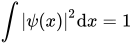

The distribution of the particle described by is given by:
| Integral Notation | Dirac Notation |
|---|---|


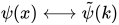
In the Copenhagen Interpretation, is the probability of finding the particle at location . In Universal Wave Function interpretations (e.g. MWI), can be thought of as the spatial distribution of the particle. The wavefunction contains all the information one can know about a system. It can thus be thought of as 'being' the particle/system in question. However, the wavefunction can be described in an infinite number of different ways. That is, there is not a unique basis for describing the wavefunction. So, for instance, one can describe the wavefunction using position-space or momentum-space:


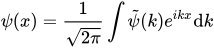
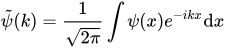
These representations can be inter-related (c.f. Fourier transform):
Wave packet
TBD

