Quantum mechanics is a theory that describes the interactions of all particles and systems. It underlies all physical phenomena, including scattering.
Wavefunction
A quantum system is completely specified by its Wave Function:
| Integral Notation
|
Dirac Notation
|

|

|
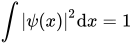
The wavefunction is typically normalized:
| Integral Notation
|
Dirac Notation
|
|

|
The distribution of the particle described by is given by:
| Integral Notation
|
Dirac Notation
|

|

|
In the Copenhagen Interpretation,  is the probability of finding the particle at location
  . In Universal Wave Function interpretations (e.g. MWI), can be thought of as the spatial distribution of the particle. The wavefunction contains all the information one can know about a system. It can thus be thought of as 'being' the particle/system in question. However, the wavefunction can be described in an infinite number of different ways. That is, there is not a unique basis for describing the wavefunction. So, for instance, one can describe the wavefunction using position-space or momentum-space:
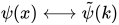
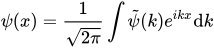
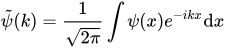
These representations can be inter-related (c.f. Fourier transform):
State
Note that the wavefunction describes the state of the system; there are various choices of basis one can use as an expansion.
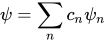
This can also be viewed as a vector in the Hilbert space. The Dirac notation (bra-ket notation) is useful in this regard. A particular state is a (column) vector:
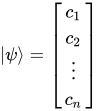
Which is a 'ket'. We define a 'bra' (the 'final state') as a (row) vector:

And note that the 'bra' is the conjuagte transpose of the 'ket':

TBD
Heisenberg Indeterminacy Relations
(Also known as Heisenberg Uncertainty Principle.)


Superposition
If  and
and  are both allowed states for a given system, then the following state is also allowed:

This leads to a notable consequence:

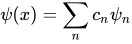
Notice that the final terms represent 'interference' between the two constituent states. This interference has no classical analogue; it is a quantum effect. Thus a superposition is not merely a 'joining' of the two states (e.g. "the particle can be in state 1 or state 2"), but a truly coherent interference between the two states. The superposition may be more generally written as:
| Integral Notation
|
Dirac Notation
|
|
|
|
The distribution of the particle described by is given by:
| Integral Notation
|
Dirac Notation
|
|

|
Operators
Observables in QM appears as operators ( ).
).
Examples: TBD.
Measurement
The transition of the wavefunction  into state
  can be thought of as:

|

|
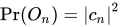
When acting on a wavefunction with operator the probability that the wavefunction ends up in state  is given by:
|

|
The solutions take the form of an eigenvalue problem:

The allowed solutions of the equation, for operator , involve an eigenstate with associated eigenvalue  . A measurement on a quantum system can be thought of as driving the wavefunction into an eigenstate defined by the operator; the value of the associated observable is then fixed to be the corresponding eigenvalue. (As noted above, the probability of ending up in a particular eigenstate is regulated by the coefficient of that eigenstate in the original wavefunction decomposition.)
See Also

