Quantum Mechanics
Quantum mechanics is a theory that describes the interactions of all particles and systems. It underlies all physical phenomena, including scattering.
Contents
Wavefunction
A quantum system is completely specified by its Wave Function:
| Integral Notation | Dirac Notation |
|---|---|
| Failed to parse (MathML with SVG or PNG fallback (recommended for modern browsers and accessibility tools): Invalid response ("Math extension cannot connect to Restbase.") from server "https://wikimedia.org/api/rest_v1/":): {\displaystyle \psi(x) } | Failed to parse (MathML with SVG or PNG fallback (recommended for modern browsers and accessibility tools): Invalid response ("Math extension cannot connect to Restbase.") from server "https://wikimedia.org/api/rest_v1/":): {\displaystyle \langle x | \psi \rangle } |
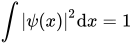
The wavefunction is typically normalized:
| Integral Notation | Dirac Notation |
|---|---|
| Failed to parse (MathML with SVG or PNG fallback (recommended for modern browsers and accessibility tools): Invalid response ("Math extension cannot connect to Restbase.") from server "https://wikimedia.org/api/rest_v1/":): {\displaystyle \int | \psi(x) |^2 \mathrm{d}x = 1} | Failed to parse (MathML with SVG or PNG fallback (recommended for modern browsers and accessibility tools): Invalid response ("Math extension cannot connect to Restbase.") from server "https://wikimedia.org/api/rest_v1/":): {\displaystyle \langle \psi | \psi \rangle = 1} |
The distribution of the particle described by Failed to parse (MathML with SVG or PNG fallback (recommended for modern browsers and accessibility tools): Invalid response ("Math extension cannot connect to Restbase.") from server "https://wikimedia.org/api/rest_v1/":): {\displaystyle \psi(x)} is given by:
| Integral Notation | Dirac Notation |
|---|---|


In the Copenhagen Interpretation, is the probability of finding the particle at location . In Universal Wave Function interpretations (e.g. MWI), can be thought of as the spatial distribution of the particle. The wavefunction contains all the information one can know about a system. It can thus be thought of as 'being' the particle/system in question. However, the wavefunction can be described in an infinite number of different ways. That is, there is not a unique basis for describing the wavefunction. So, for instance, one can describe the wavefunction using position-space or momentum-space:


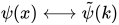
These representations can be inter-related (c.f. Fourier transform):
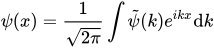
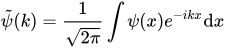

|

|
| Example of a 1D wavefunction (plotted versus 'x'). The upper panel shows the amplitude-squared, while the lower panel shows the corresponding wavefunction components: real (black line) and imaginary (blue line). |
State
Note that the wavefunction describes the state of the system; there are various choices of basis one can use as an expansion.
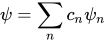
A basis should be orthonormal:
| Integral Notation | Dirac Notation | |
|---|---|---|
| normalized | ||
| orthogonal |
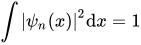

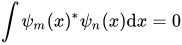
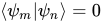
An operator defines a particular convenient basis: one can always expand using the basis defined by an operator, in which case the above are the eigenvectors (or eigenstates) of that basis. This can also be viewed as a vector in the Hilbert space. The Dirac notation (bra-ket notation) is useful in this regard. A particular state is a (column) vector:


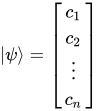
Which is a 'ket'. We define a 'bra' (the 'final state') as a (row) vector:

And note that the 'bra' is the conjuagte transpose of the 'ket':

Wave packet
A wave packet is a localized wavelike perturbation. Particles in quantum mechanics can be thought of as wave-packets.
.gif)
Note that "wave-particle duality" can be misleading. One can imagine a quantum particle as "both a wave and a particle"; however, it might be better to instead imagine it as a "wave packet". The 'particle' and 'wave' descriptions are really idealized limiting cases, which never appear in reality:
- A classical 'particle' is a point-like object. In QM would have a corresponding infinite spread in its momentum. Such an idealized (infinitely small) entity cannot truly exist.
- A classical 'wave' is a plane wave: an oscillation with a perfectly well-defined wavelength, extending infinitely in both directions. In QM, we indeed note that having a precisely-defined wavelength (momentum) implies infinite spatial spread (i.e. the wave fills the entire universe). Such a construct is not physically-realizable.
Heisenberg Indeterminacy Relations
(Also known as Heisenberg Uncertainty Principle.)


Superposition
If and are both allowed states for a given system, then the following state is also allowed:



This leads to a notable consequence:

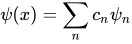
Notice that the final terms represent 'interference' between the two constituent states. This interference has no classical analogue; it is a quantum effect. Thus a superposition is not merely a 'joining' of the two states (e.g. "the particle can be in state 1 or state 2"), but a truly coherent interference between the two states. The superposition may be more generally written as:
| Integral Notation | Dirac Notation |
|---|---|

The distribution of the particle described by is given by:

| Integral Notation | Dirac Notation |
|---|---|

Operators
Observables in QM appears as operators ().

Examples: TBD.
Measurement
The transition of the wavefunction into state can be thought of as:



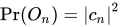
When acting on a wavefunction with operator the probability that the wavefunction ends up in state is given by:


The solutions take the form of an eigenvalue problem:
- Failed to parse (MathML with SVG or PNG fallback (recommended for modern browsers and accessibility tools): Invalid response ("Math extension cannot connect to Restbase.") from server "https://wikimedia.org/api/rest_v1/":): {\displaystyle \hat{O} \phi_n = o_n \phi_n}
The allowed solutions of the equation, for operator Failed to parse (MathML with SVG or PNG fallback (recommended for modern browsers and accessibility tools): Invalid response ("Math extension cannot connect to Restbase.") from server "https://wikimedia.org/api/rest_v1/":): {\displaystyle \hat{O}} , involve an eigenstate with associated eigenvalue Failed to parse (MathML with SVG or PNG fallback (recommended for modern browsers and accessibility tools): Invalid response ("Math extension cannot connect to Restbase.") from server "https://wikimedia.org/api/rest_v1/":): {\displaystyle o_n} . A measurement on a quantum system can be thought of as driving the wavefunction into an eigenstate defined by the operator; the value of the associated observable is then fixed to be the corresponding eigenvalue. (As noted above, the probability of ending up in a particular eigenstate is regulated by the coefficient of that eigenstate in the original wavefunction decomposition.)
Expectation value
A given operator, e.g. , implies an expectation value (for state Failed to parse (MathML with SVG or PNG fallback (recommended for modern browsers and accessibility tools): Invalid response ("Math extension cannot connect to Restbase.") from server "https://wikimedia.org/api/rest_v1/":): {\displaystyle \psi} ) of:

| Failed to parse (MathML with SVG or PNG fallback (recommended for modern browsers and accessibility tools): Invalid response ("Math extension cannot connect to Restbase.") from server "https://wikimedia.org/api/rest_v1/":): {\displaystyle \langle A \rangle_{\psi} = \int \psi^* \hat{A} \psi \mathrm{d}x } | Failed to parse (MathML with SVG or PNG fallback (recommended for modern browsers and accessibility tools): Invalid response ("Math extension cannot connect to Restbase.") from server "https://wikimedia.org/api/rest_v1/":): {\displaystyle \langle A \rangle_{\psi} = \langle \psi | \hat{A} | \psi \rangle } |
If the system is in an eigenstate of the operator:
- Failed to parse (MathML with SVG or PNG fallback (recommended for modern browsers and accessibility tools): Invalid response ("Math extension cannot connect to Restbase.") from server "https://wikimedia.org/api/rest_v1/":): {\displaystyle \psi = \sum_n c_n \psi_n = \psi_n }
We know that:
- Failed to parse (MathML with SVG or PNG fallback (recommended for modern browsers and accessibility tools): Invalid response ("Math extension cannot connect to Restbase.") from server "https://wikimedia.org/api/rest_v1/":): {\displaystyle \hat{A} \psi_n = a_n \psi_n }
And so:
- Failed to parse (MathML with SVG or PNG fallback (recommended for modern browsers and accessibility tools): Invalid response ("Math extension cannot connect to Restbase.") from server "https://wikimedia.org/api/rest_v1/":): {\displaystyle \begin{alignat}{2} \langle A \rangle & = \int \psi_n^* \hat{A} \psi_n \mathrm{d}x \\ & = \int \psi^* a_n \psi \mathrm{d}x \\ & = a_n \int \psi^* \psi \mathrm{d}x \\ & = a_n \\ \end{alignat} }
In other words, the expectation value of an eigenstate is simply the eigenvalue.
Schrödinger Equation
Time-independent equation
This simplified version of the Schrödinger equation can be used to solve for allowed stationary states. The general form is akin to the eigenvalue problems noted above: the energy operator (Failed to parse (MathML with SVG or PNG fallback (recommended for modern browsers and accessibility tools): Invalid response ("Math extension cannot connect to Restbase.") from server "https://wikimedia.org/api/rest_v1/":): {\displaystyle \hat{H}} ) acts on the system state (Failed to parse (MathML with SVG or PNG fallback (recommended for modern browsers and accessibility tools): Invalid response ("Math extension cannot connect to Restbase.") from server "https://wikimedia.org/api/rest_v1/":): {\displaystyle \Psi} ) to yield an energy eigenvalue (Failed to parse (MathML with SVG or PNG fallback (recommended for modern browsers and accessibility tools): Invalid response ("Math extension cannot connect to Restbase.") from server "https://wikimedia.org/api/rest_v1/":): {\displaystyle E} ):
- Failed to parse (MathML with SVG or PNG fallback (recommended for modern browsers and accessibility tools): Invalid response ("Math extension cannot connect to Restbase.") from server "https://wikimedia.org/api/rest_v1/":): {\displaystyle E\Psi=\hat H \Psi}
For a single non-relativistic particle, the Hamiltonian is known and the Schrödinger equation takes the form:
- Failed to parse (MathML with SVG or PNG fallback (recommended for modern browsers and accessibility tools): Invalid response ("Math extension cannot connect to Restbase.") from server "https://wikimedia.org/api/rest_v1/":): {\displaystyle E \Psi(\mathbf{r}) = \left[ \frac{-\hbar^2}{2m}\nabla^2 + V(\mathbf{r}) \right] \Psi(\mathbf{r})}
Time-dependent equation
More generally, the time-evolution of the wavefunction should be considered. The full version of the Schrödinger equation thus includes time dependence:
- Failed to parse (MathML with SVG or PNG fallback (recommended for modern browsers and accessibility tools): Invalid response ("Math extension cannot connect to Restbase.") from server "https://wikimedia.org/api/rest_v1/":): {\displaystyle i \hbar \frac{\partial}{\partial t}\Psi = \hat H \Psi}
Again for a single non-relativistic particle, we can write more specifically that:
- Failed to parse (MathML with SVG or PNG fallback (recommended for modern browsers and accessibility tools): Invalid response ("Math extension cannot connect to Restbase.") from server "https://wikimedia.org/api/rest_v1/":): {\displaystyle i\hbar\frac{\partial}{\partial t} \Psi(\mathbf{r},t) = \left [ \frac{-\hbar^2}{2\mu}\nabla^2 + V(\mathbf{r},t)\right ] \Psi(\mathbf{r},t)}
Entanglement
When systems (or Hilbert spaces) A and B interact, they become entangled. Before the interaction, the two systems are simply a composite system:
- Failed to parse (MathML with SVG or PNG fallback (recommended for modern browsers and accessibility tools): Invalid response ("Math extension cannot connect to Restbase.") from server "https://wikimedia.org/api/rest_v1/":): {\displaystyle |\psi\rangle_A \otimes |\phi\rangle_B}
At this level, states are separable. However, the composite system more generally should be written as:
- Failed to parse (MathML with SVG or PNG fallback (recommended for modern browsers and accessibility tools): Invalid response ("Math extension cannot connect to Restbase.") from server "https://wikimedia.org/api/rest_v1/":): {\displaystyle |\psi\rangle_{AB} = \sum_{i,j} c_{ij} |i\rangle_A \otimes |j\rangle_B}
If all the coefficients can be written as Failed to parse (MathML with SVG or PNG fallback (recommended for modern browsers and accessibility tools): Invalid response ("Math extension cannot connect to Restbase.") from server "https://wikimedia.org/api/rest_v1/":): {\displaystyle \scriptstyle c_{ij}= c^A_ic^B_j,} , then there is no coupling between the two states. We call the system separable, since it can be decomposed into the two sub-systems:
- Failed to parse (MathML with SVG or PNG fallback (recommended for modern browsers and accessibility tools): Invalid response ("Math extension cannot connect to Restbase.") from server "https://wikimedia.org/api/rest_v1/":): {\displaystyle |\psi\rangle_A = \sum_{i} c^A_{i} |i\rangle_A}
- Failed to parse (MathML with SVG or PNG fallback (recommended for modern browsers and accessibility tools): Invalid response ("Math extension cannot connect to Restbase.") from server "https://wikimedia.org/api/rest_v1/":): {\displaystyle |\phi\rangle_B = \sum_{j} c^B_{j} |j\rangle_B}
However, if , then the state are non-separable, or entangled:

Density Matrices
The outer product of a ket with a bra defines a 2D matrix; i.e. a linear operator.
- Failed to parse (MathML with SVG or PNG fallback (recommended for modern browsers and accessibility tools): Invalid response ("Math extension cannot connect to Restbase.") from server "https://wikimedia.org/api/rest_v1/":): {\displaystyle |\phi \rangle \langle \psi | = \begin{pmatrix} \phi_1 \\ \phi_2 \\ \vdots \\ \phi_N \end{pmatrix} \begin{pmatrix} \psi_1^* & \psi_2^* & \cdots & \psi_N^* \end{pmatrix} = \begin{pmatrix} \phi_1 \psi_1^* & \phi_1 \psi_2^* & \cdots & \phi_1 \psi_N^* \\ \phi_2 \psi_1^* & \phi_2 \psi_2^* & \cdots & \phi_2 \psi_N^* \\ \vdots & \vdots & \ddots & \vdots \\ \phi_N \psi_1^* & \phi_N \psi_2^* & \cdots & \phi_N \psi_N^* \end{pmatrix} }
Density matrices can be a useful way to visualize the interactions between states of a system. For instance, a pure state is given by a density matrix that has only a single non-zero term, along the diagonal:
- Failed to parse (MathML with SVG or PNG fallback (recommended for modern browsers and accessibility tools): Invalid response ("Math extension cannot connect to Restbase.") from server "https://wikimedia.org/api/rest_v1/":): {\displaystyle | \psi \rangle \langle \psi | = 1 }
Decoherence
TBD

