Reflectivity

From GISAXS
Revision as of 15:05, 28 January 2015 by KevinYager (talk | contribs)
Jump to: navigation, search

Reflectivity refers to the measurement of the intensity of reflection off of a flat interface. The term both describes the physical phenomenon, as well as the experimental technique.

X-ray Reflectivity (XRR or XR) and neutron reflectivity (NR) are techniques which measure the intensity of reflected radiation as a function of angle (where, by definition for specular reflectivity, the incident and exit angles are equal; Failed to parse (MathML with SVG or PNG fallback (recommended for modern browsers and accessibility tools): Invalid response ("Math extension cannot connect to Restbase.") from server "https://wikimedia.org/api/rest_v1/":): {\displaystyle \scriptstyle \theta_i = \theta_f} ). A plot of reflectivity (R) versus angle yields the reflectivity curve. For XR and NR, the data is typically plotted as a function of the momentum transfer parallel to the film normal:

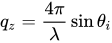
Failed to parse (MathML with SVG or PNG fallback (recommended for modern browsers and accessibility tools): Invalid response ("Math extension cannot connect to Restbase.") from server "https://wikimedia.org/api/rest_v1/":): {\displaystyle q_z = \frac{4\pi}{\lambda} \sin \theta_i }
Reflectivity calculation for a thin film.

Off-Specular Reflectivity

TBD

Mathematical form

Ideal interface

In its simplest form, the Fresnel reflectivity can be given by:
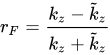
Failed to parse (MathML with SVG or PNG fallback (recommended for modern browsers and accessibility tools): Invalid response ("Math extension cannot connect to Restbase.") from server "https://wikimedia.org/api/rest_v1/":): {\displaystyle r_F = \frac{k_z-\tilde{k}_z}{k_z+\tilde{k}_z} }

Where Failed to parse (MathML with SVG or PNG fallback (recommended for modern browsers and accessibility tools): Invalid response ("Math extension cannot connect to Restbase.") from server "https://wikimedia.org/api/rest_v1/":): {\displaystyle \scriptstyle k_z} is the vertical (z) component of the momentum of the incident wave, and Failed to parse (MathML with SVG or PNG fallback (recommended for modern browsers and accessibility tools): Invalid response ("Math extension cannot connect to Restbase.") from server "https://wikimedia.org/api/rest_v1/":): {\displaystyle \scriptstyle \tilde{k}_z} is the vertical component of the transmitted wave:

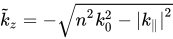
Failed to parse (MathML with SVG or PNG fallback (recommended for modern browsers and accessibility tools): Invalid response ("Math extension cannot connect to Restbase.") from server "https://wikimedia.org/api/rest_v1/":): {\displaystyle \tilde{k}_z = - \sqrt{ n^2 k^2_0 - |k_{\parallel}|^2 } }

and n is the complex refractive index of the substrate. The reflected intensity (which is what is measured experimentally) is Failed to parse (MathML with SVG or PNG fallback (recommended for modern browsers and accessibility tools): Invalid response ("Math extension cannot connect to Restbase.") from server "https://wikimedia.org/api/rest_v1/":): {\displaystyle R_F = |r_f|^2} . Close to the critical angle (Failed to parse (MathML with SVG or PNG fallback (recommended for modern browsers and accessibility tools): Invalid response ("Math extension cannot connect to Restbase.") from server "https://wikimedia.org/api/rest_v1/":): {\displaystyle \scriptstyle \theta_i \approx \theta_c} ), the beam is strongly refracted and:

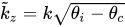
Failed to parse (MathML with SVG or PNG fallback (recommended for modern browsers and accessibility tools): Invalid response ("Math extension cannot connect to Restbase.") from server "https://wikimedia.org/api/rest_v1/":): {\displaystyle \tilde{k}_z = k \sqrt{ \theta_i - \theta_c } }

Thus, when the incident angle is less than the critical angle (Failed to parse (MathML with SVG or PNG fallback (recommended for modern browsers and accessibility tools): Invalid response ("Math extension cannot connect to Restbase.") from server "https://wikimedia.org/api/rest_v1/":): {\displaystyle \scriptstyle \theta_i < \theta_c} ), the transmitted wave-vector is purely imaginary: \tilde{k}_z = i k \sqrt{ \theta_c - \theta_i } This corresponds to the wave being totally externally reflected (evanescent probing only). Above the critical angle, the reflected intensity falls off rapidly: Failed to parse (MathML with SVG or PNG fallback (recommended for modern browsers and accessibility tools): Invalid response ("Math extension cannot connect to Restbase.") from server "https://wikimedia.org/api/rest_v1/":): {\displaystyle R_F \sim \theta_i^{-4}} (c.f. Fresnel plot).

Rough interface

A flat interface with a small amount of roughness can be modelled using idealized uncorrelated roughness, which is characterized by a mean standard deviation of the height Failed to parse (MathML with SVG or PNG fallback (recommended for modern browsers and accessibility tools): Invalid response ("Math extension cannot connect to Restbase.") from server "https://wikimedia.org/api/rest_v1/":): {\displaystyle \scriptstyle \sigma = \sqrt{ \left \langle h^2 \right \rangle }} :

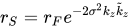
Failed to parse (MathML with SVG or PNG fallback (recommended for modern browsers and accessibility tools): Invalid response ("Math extension cannot connect to Restbase.") from server "https://wikimedia.org/api/rest_v1/":): {\displaystyle r_S = r_F e^{ -2 \sigma^2 k_z \tilde{k}_z } }

For a substrate with a single continuous layer of thickness h (e.g. a uniform thin film), the reflectivity becomes:
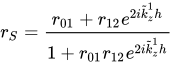
Failed to parse (MathML with SVG or PNG fallback (recommended for modern browsers and accessibility tools): Invalid response ("Math extension cannot connect to Restbase.") from server "https://wikimedia.org/api/rest_v1/":): {\displaystyle r_S = \frac{ r_{01} + r_{12} e^{ 2i \tilde{k}^1_z h } }{ 1 + r_{01} r_{12} e^{ 2i \tilde{k}^1_z h } } }

where

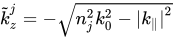
Failed to parse (MathML with SVG or PNG fallback (recommended for modern browsers and accessibility tools): Invalid response ("Math extension cannot connect to Restbase.") from server "https://wikimedia.org/api/rest_v1/":): {\displaystyle \tilde{k}^j_z = - \sqrt{ n^2_j k^2_0 - |k_{\parallel}|^2 }}

is the perpendicular component of the wave-vector (in medium j). The reflectivity coefficients are:
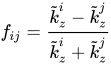
Failed to parse (MathML with SVG or PNG fallback (recommended for modern browsers and accessibility tools): Invalid response ("Math extension cannot connect to Restbase.") from server "https://wikimedia.org/api/rest_v1/":): {\displaystyle f_{ij} = \frac{ \tilde{k}^i_z - \tilde{k}^j_z }{ \tilde{k}^i_z + \tilde{k}^j_z } }

Where Failed to parse (MathML with SVG or PNG fallback (recommended for modern browsers and accessibility tools): Invalid response ("Math extension cannot connect to Restbase.") from server "https://wikimedia.org/api/rest_v1/":): {\displaystyle \scriptstyle r_{01}} and Failed to parse (MathML with SVG or PNG fallback (recommended for modern browsers and accessibility tools): Invalid response ("Math extension cannot connect to Restbase.") from server "https://wikimedia.org/api/rest_v1/":): {\displaystyle \scriptstyle r_{12}} for the vacuum-layer and layer-substrate interfaces, respectively. This is called the 'one-box model'.

Multiple interfaces: Parratt formalism

The reflectivity from a stack of different layers can be computed using the so-called Parratt recursion formalism, which accounts for the effect of reflection from each internal interface, including their coherent interference to yield the final reflection intensity. This formalism can, in fact, be used to simulate or fit an arbitrary electron-density distribution (in the film-normal direction). Any continuous variation of density can be simulated by discretizing the system into a finite number of layers of finite thickness.

The Parratt formalism is recursive

Master-Formula

TBD

See Also