Talk:Scattering
Revision as of 17:45, 29 December 2015 by KevinYager (talk | contribs) (Created page with "===TSAXS 3d=== The ''q''-vector in fact has three components: :<math> \mathbf{q} = \begin{bmatrix} q_x & q_y & q_z \end{bmatrix} </math> Consider that the x-ray beam p...")
TSAXS 3d
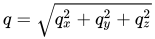
The q-vector in fact has three components:

Consider that the x-ray beam points along +y, so that on the detector, the horizontal is x, and the vertical is z. We assume that the x-ray beam hits the flat 2D area detector at 90° at detector (pixel) position . The scattering angles are then:

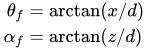
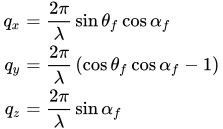
where is the sample-detector distance, is the out-of-plane component (angle w.r.t. to y-axis, rotation about x-axis), and is the in-plane component (rotation about z-axis). The momentum transfer components are:


And, of course: