|
|
| Line 99: |
Line 99: |
| | | | |
| | We can rewrite in a more compact form using the notation <math>T_i = T(\alpha_i)</math> and <math>F_{+1} = F(+Q_{z1})</math>: | | We can rewrite in a more compact form using the notation <math>T_i = T(\alpha_i)</math> and <math>F_{+1} = F(+Q_{z1})</math>: |
| | + | |
| | <math> | | <math> |
| | \begin{align} | | \begin{align} |
Revision as of 10:00, 7 March 2018
DWBA Equation in thin film
Using the notation  for compactness, the DWBA equation inside a thin film can be written:

Expansion
Terms
If one expands the  of the DWBA, one obtains 16 terms:
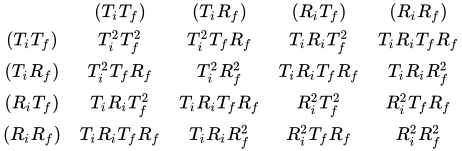
Equation
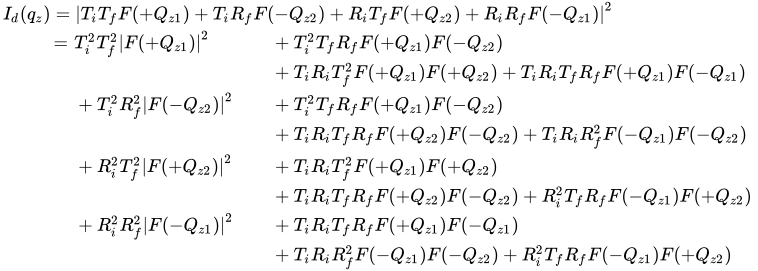
The equation can thus be expanded as:
Simplification
We can rearrange to:
![{\displaystyle {\begin{aligned}I_{d}(q_{z})=\,\,&T_{i}^{2}T_{f}^{2}|F(+Q_{z1})|^{2}+T_{i}^{2}R_{f}^{2}|F(-Q_{z2})|^{2}+R_{i}^{2}T_{f}^{2}|F(+Q_{z2})|^{2}+R_{i}^{2}R_{f}^{2}|F(-Q_{z1})|^{2}\\&+T_{i}^{2}T_{f}R_{f}F(+Q_{z1})F(-Q_{z2})\\&+T_{i}R_{i}T_{f}^{2}F(+Q_{z1})F(+Q_{z2})+T_{i}R_{i}T_{f}R_{f}F(+Q_{z1})F(-Q_{z1})\\&+T_{i}^{2}T_{f}R_{f}F(+Q_{z1})F(-Q_{z2})\\&+T_{i}R_{i}T_{f}R_{f}F(+Q_{z2})F(-Q_{z2})+T_{i}R_{i}R_{f}^{2}F(-Q_{z1})F(-Q_{z2})\\&+T_{i}R_{i}T_{f}^{2}F(+Q_{z1})F(+Q_{z2})\\&+T_{i}R_{i}T_{f}R_{f}F(+Q_{z2})F(-Q_{z2})+R_{i}^{2}T_{f}R_{f}F(-Q_{z1})F(+Q_{z2})\\&+T_{i}R_{i}T_{f}R_{f}F(+Q_{z1})F(-Q_{z1})\\&+T_{i}R_{i}R_{f}^{2}F(-Q_{z1})F(-Q_{z2})+R_{i}^{2}T_{f}R_{f}F(-Q_{z1})F(+Q_{z2})\\=\,\,&T_{i}^{2}T_{f}^{2}|F(+Q_{z1})|^{2}+T_{i}^{2}R_{f}^{2}|F(-Q_{z2})|^{2}+R_{i}^{2}T_{f}^{2}|F(+Q_{z2})|^{2}+R_{i}^{2}R_{f}^{2}|F(-Q_{z1})|^{2}\\&+2\times T_{i}^{2}T_{f}R_{f}F(+Q_{z1})F(-Q_{z2})\\&+2\times T_{i}R_{i}T_{f}^{2}F(+Q_{z1})F(-Q_{z2})\\&+2\times T_{i}R_{i}T_{f}R_{f}[F(+Q_{z1})F(-Q_{z1})+F(+Q_{z2})F(-Q_{z2})]\\&+2\times T_{i}R_{i}R_{f}^{2}F(-Q_{z1})F(-Q_{z2})\\&+2\times R_{i}^{2}T_{f}R_{f}xF(-Q_{z1})F(+Q_{z2})\\=\,\,&T_{i}^{2}T_{f}^{2}|F(+Q_{z1})|^{2}+T_{i}^{2}R_{f}^{2}|F(-Q_{z2})|^{2}+R_{i}^{2}T_{f}^{2}|F(+Q_{z2})|^{2}+R_{i}^{2}R_{f}^{2}|F(-Q_{z1})|^{2}\\&+2\times T_{i}^{2}T_{f}R_{f}F(+Q_{z1})F(-Q_{z2})+2\times T_{i}R_{i}T_{f}^{2}F(+Q_{z1})F(-Q_{z2})\\&+2\times T_{i}R_{i}T_{f}R_{f}[F(+Q_{z1})F(-Q_{z1})+F(+Q_{z2})F(-Q_{z2})]\\&+2\times T_{i}R_{i}R_{f}^{2}F(-Q_{z1})F(-Q_{z2})+2\times R_{i}^{2}T_{f}R_{f}xF(-Q_{z1})F(+Q_{z2})\\\end{aligned}}}](https://wikimedia.org/api/rest_v1/media/math/render/svg/ce579c7545b64735adca6f459c20fffa66b43254)
We can rewrite in a more compact form using the notation and  :
:
![{\displaystyle {\begin{aligned}I_{d}(q_{z})=\,\,&T_{i}^{2}T_{f}^{2}|F_{+1}|^{2}+T_{i}^{2}R_{f}^{2}|F_{-2}|^{2}+R_{i}^{2}T_{f}^{2}|F_{+2}|^{2}+R_{i}^{2}R_{f}^{2}|F_{-1}|^{2}\\&+2\times T_{i}^{2}T_{f}R_{f}F_{+1}F_{-2}+2\times T_{i}R_{i}T_{f}^{2}F_{+1}F_{-2}\\&+2\times T_{i}R_{i}T_{f}R_{f}[F_{+1}F_{-1}+F_{+2}F_{-2}]\\&+2\times T_{i}R_{i}R_{f}^{2}F_{-1}F_{-2}+2\times R_{i}^{2}T_{f}R_{f}F_{-1}F_{+2}\end{aligned}}}](https://wikimedia.org/api/rest_v1/media/math/render/svg/3088f53fdc40c571346111b2ad009bc0d625efaa)

