|
|
| Line 43: |
Line 43: |
| | </math> | | </math> |
| | | | |
| − | The point <math>\scriptstyle (x,z)=(0,0) </math> on the detector probes the total scattering angle: | + | The point <math>\scriptstyle (x,z)=(0,0) </math> on the detector probes the total scattering angle <math>\scriptstyle \Theta = 2 \theta_s</math>, which is simply the angle between <math>\scriptstyle \mathbf{v}_i</math> and <math>\scriptstyle \mathbf{v}_f</math>: |
| | :<math> | | :<math> |
| | \begin{alignat}{2} | | \begin{alignat}{2} |
| − | 2 \theta_s = \Theta & = 1 \\
| + | \cos \Theta & = \frac{ \mathbf{v}_i \cdot \mathbf{v}_f }{ \left\| \mathbf{v}_i \right\| \left\| \mathbf{v}_f \right\|} \\ |
| − | & = 1 | + | & = \cos \phi_g \cos \theta_g \\ |
| | + | 2 \theta_s & = \arccos \left[ \cos \phi_g \cos \theta_g \right] |
| | \end{alignat} | | \end{alignat} |
| | </math> | | </math> |
Revision as of 11:10, 13 January 2016
In wide-angle scattering (WAXS), one cannot simply assume that the detector plane is orthogonal to the incident x-ray beam. Converting from detector pixel coordinates to 3D q-vector is not always trivial, and depends on the experimental geometry.
Area Detector on Goniometer Arm
Consider a 2D (area) detector connected to a goniometer arm. The goniometer has a center of rotation at the center of the sample (i.e. the incident beam passes through this center, and scattered rays originate from this point also). Let  be the in-plane angle of the goniometer arm (rotation about
  -axis), and
  be the elevation angle (rotation away from
  plane and towards axis).
The final scattering vector depends on:
 : Pixel position on detector (horizontal).
- : Pixel position on detector (vertical).
 : Sample-detector distance.
- : Elevation angle of detector.
- : In-plane angle of detector.
Note that and are defined relative to the direct-beam. That is, for  and
and  , the direct beam is at position
  on the area detector.
Central Point
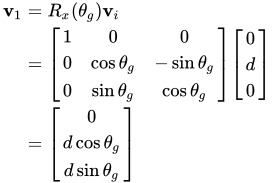
The point can be thought of in terms of a vector that points from the source-of-scattering (center of goniometer rotation) to the detector:

This vector is then rotated about the -axis by :
And then rotated about the -axis by :
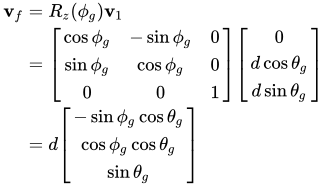
The point on the detector probes the total scattering angle  , which is simply the angle between
  and
and  :
:
![{\displaystyle {\begin{alignedat}{2}\cos \Theta &={\frac {\mathbf {v} _{i}\cdot \mathbf {v} _{f}}{\left\|\mathbf {v} _{i}\right\|\left\|\mathbf {v} _{f}\right\|}}\\&=\cos \phi _{g}\cos \theta _{g}\\2\theta _{s}&=\arccos \left[\cos \phi _{g}\cos \theta _{g}\right]\end{alignedat}}}](https://wikimedia.org/api/rest_v1/media/math/render/svg/16f579eadf3797f5e60e452d03043fd715a20db0)
See Also

