DWBA Equation in thin film
Using the notation Failed to parse (MathML with SVG or PNG fallback (recommended for modern browsers and accessibility tools): Invalid response ("Math extension cannot connect to Restbase.") from server "https://wikimedia.org/api/rest_v1/":): {\displaystyle T_i = T(\alpha_i)}
for compactness, the DWBA equation inside a thin film can be written:
Failed to parse (MathML with SVG or PNG fallback (recommended for modern browsers and accessibility tools): Invalid response ("Math extension cannot connect to Restbase.") from server "https://wikimedia.org/api/rest_v1/":): {\displaystyle \begin{align} I_d(q_{z}) & = | T_i T_f F(+Q_{z1}) + T_i R_f F(-Q_{z2}) + R_i T_f F(+Q_{z2}) + R_i R_f F(-Q_{z1}) | ^{2} \\ \end{align} }
Expansion (incorrect)
WARNING: This incorrectly ignores the complex components.
Terms
If one expands the Failed to parse (MathML with SVG or PNG fallback (recommended for modern browsers and accessibility tools): Invalid response ("Math extension cannot connect to Restbase.") from server "https://wikimedia.org/api/rest_v1/":): {\displaystyle |...|^2}
of the DWBA, one obtains 16 terms:
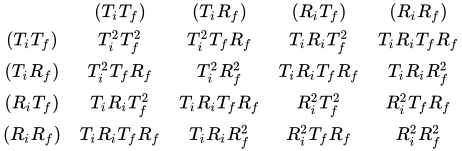
Equation
The equation can thus be expanded as:
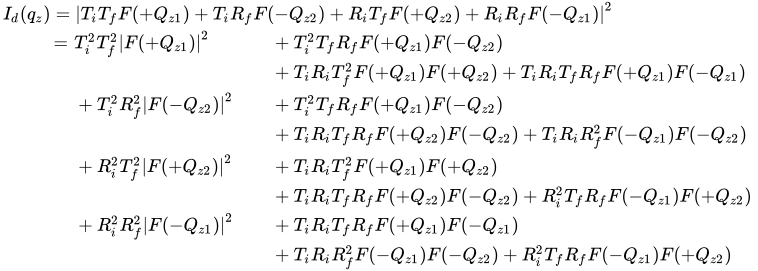
Simplification
We can rearrange to:
![{\displaystyle {\begin{aligned}I_{d}(q_{z})=\,\,&T_{i}^{2}T_{f}^{2}|F(+Q_{z1})|^{2}+T_{i}^{2}R_{f}^{2}|F(-Q_{z2})|^{2}+R_{i}^{2}T_{f}^{2}|F(+Q_{z2})|^{2}+R_{i}^{2}R_{f}^{2}|F(-Q_{z1})|^{2}\\&+T_{i}^{2}T_{f}R_{f}F(+Q_{z1})F(-Q_{z2})\\&+T_{i}R_{i}T_{f}^{2}F(+Q_{z1})F(+Q_{z2})+T_{i}R_{i}T_{f}R_{f}F(+Q_{z1})F(-Q_{z1})\\&+T_{i}^{2}T_{f}R_{f}F(+Q_{z1})F(-Q_{z2})\\&+T_{i}R_{i}T_{f}R_{f}F(+Q_{z2})F(-Q_{z2})+T_{i}R_{i}R_{f}^{2}F(-Q_{z1})F(-Q_{z2})\\&+T_{i}R_{i}T_{f}^{2}F(+Q_{z1})F(+Q_{z2})\\&+T_{i}R_{i}T_{f}R_{f}F(+Q_{z2})F(-Q_{z2})+R_{i}^{2}T_{f}R_{f}F(-Q_{z1})F(+Q_{z2})\\&+T_{i}R_{i}T_{f}R_{f}F(+Q_{z1})F(-Q_{z1})\\&+T_{i}R_{i}R_{f}^{2}F(-Q_{z1})F(-Q_{z2})+R_{i}^{2}T_{f}R_{f}F(-Q_{z1})F(+Q_{z2})\\=\,\,&T_{i}^{2}T_{f}^{2}|F(+Q_{z1})|^{2}+T_{i}^{2}R_{f}^{2}|F(-Q_{z2})|^{2}+R_{i}^{2}T_{f}^{2}|F(+Q_{z2})|^{2}+R_{i}^{2}R_{f}^{2}|F(-Q_{z1})|^{2}\\&+2\times T_{i}^{2}T_{f}R_{f}F(+Q_{z1})F(-Q_{z2})\\&+2\times T_{i}R_{i}T_{f}^{2}F(+Q_{z1})F(+Q_{z2})\\&+2\times T_{i}R_{i}T_{f}R_{f}[F(+Q_{z1})F(-Q_{z1})+F(+Q_{z2})F(-Q_{z2})]\\&+2\times T_{i}R_{i}R_{f}^{2}F(-Q_{z1})F(-Q_{z2})\\&+2\times R_{i}^{2}T_{f}R_{f}xF(-Q_{z1})F(+Q_{z2})\\=\,\,&T_{i}^{2}T_{f}^{2}|F(+Q_{z1})|^{2}+T_{i}^{2}R_{f}^{2}|F(-Q_{z2})|^{2}+R_{i}^{2}T_{f}^{2}|F(+Q_{z2})|^{2}+R_{i}^{2}R_{f}^{2}|F(-Q_{z1})|^{2}\\&+2\times T_{i}^{2}T_{f}R_{f}F(+Q_{z1})F(-Q_{z2})+2\times T_{i}R_{i}T_{f}^{2}F(+Q_{z1})F(+Q_{z2})\\&+2\times T_{i}R_{i}T_{f}R_{f}[F(+Q_{z1})F(-Q_{z1})+F(+Q_{z2})F(-Q_{z2})]\\&+2\times T_{i}R_{i}R_{f}^{2}F(-Q_{z1})F(-Q_{z2})+2\times R_{i}^{2}T_{f}R_{f}xF(-Q_{z1})F(+Q_{z2})\\\end{aligned}}}](https://wikimedia.org/api/rest_v1/media/math/render/svg/255a3de6b04851277911d2d7c5dd1465af49d540)
We can rewrite in a more compact form using the notation  and
and  :
:
![{\displaystyle {\begin{aligned}I_{d}(q_{z})=\,\,&T_{i}^{2}T_{f}^{2}|F_{+1}|^{2}+T_{i}^{2}R_{f}^{2}|F_{-2}|^{2}+R_{i}^{2}T_{f}^{2}|F_{+2}|^{2}+R_{i}^{2}R_{f}^{2}|F_{-1}|^{2}\\&+2\times T_{i}^{2}T_{f}R_{f}F_{+1}F_{-2}+2\times T_{i}R_{i}T_{f}^{2}F_{+1}F_{+2}\\&+2\times T_{i}R_{i}T_{f}R_{f}[F_{+1}F_{-1}+F_{+2}F_{-2}]\\&+2\times T_{i}R_{i}R_{f}^{2}F_{-1}F_{-2}+2\times R_{i}^{2}T_{f}R_{f}F_{-1}F_{+2}\end{aligned}}}](https://wikimedia.org/api/rest_v1/media/math/render/svg/938b875c2cb46e82376844f6bf35b4f58fcbca4d)
Expansion
Terms
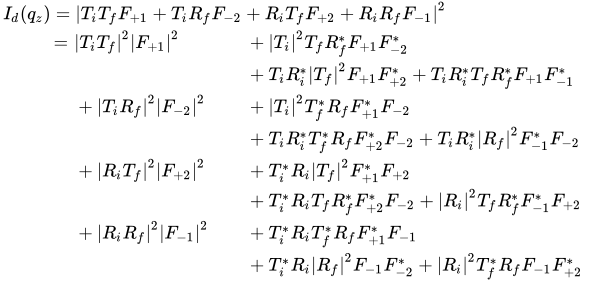
If one expands the  of the DWBA, one obtains 16 terms:
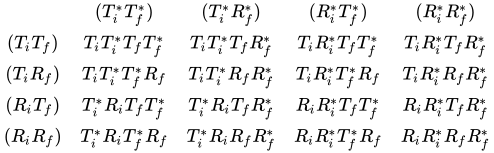
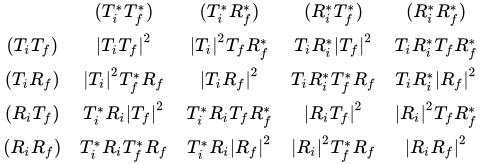
Equation
We take advantage of a more compact form using the notation and . The DWBA equation can thus be expanded as:
Simplification
We can rearrange to:
![{\displaystyle {\begin{aligned}I_{d}(q_{z})=\,\,&|T_{i}T_{f}|^{2}|F_{+1}|^{2}+|T_{i}R_{f}|^{2}|F_{-2}|^{2}+|R_{i}T_{f}|^{2}|F_{+2}|^{2}+|R_{i}R_{f}|^{2}|F_{-1}|^{2}\\&+|T_{i}|^{2}T_{f}R_{f}^{*}F_{+1}F_{-2}^{*}+|T_{i}|^{2}T_{f}^{*}R_{f}F_{+1}^{*}F_{-2}\\&+T_{i}R_{i}^{*}|T_{f}|^{2}F_{+1}F_{+2}^{*}+T_{i}^{*}R_{i}|T_{f}|^{2}F_{+1}^{*}F_{+2}\\&+|R_{i}|^{2}T_{f}R_{f}^{*}F_{-1}^{*}F_{+2}+|R_{i}|^{2}T_{f}^{*}R_{f}F_{-1}F_{+2}^{*}\\&+T_{i}R_{i}^{*}|R_{f}|^{2}F_{-1}^{*}F_{-2}+T_{i}^{*}R_{i}|R_{f}|^{2}F_{-1}F_{-2}^{*}\\&+T_{i}R_{i}^{*}T_{f}R_{f}^{*}F_{+1}F_{-1}^{*}\\&+T_{i}R_{i}^{*}T_{f}^{*}R_{f}F_{+2}^{*}F_{-2}\\&+T_{i}^{*}R_{i}T_{f}R_{f}^{*}F_{+2}^{*}F_{-2}\\&+T_{i}^{*}R_{i}T_{f}^{*}R_{f}F_{+1}^{*}F_{-1}\\=\,\,&|T_{i}T_{f}|^{2}|F_{+1}|^{2}+|T_{i}R_{f}|^{2}|F_{-2}|^{2}+|R_{i}T_{f}|^{2}|F_{+2}|^{2}+|R_{i}R_{f}|^{2}|F_{-1}|^{2}\\&+|T_{i}|^{2}[T_{f}R_{f}^{*}F_{+1}F_{-2}^{*}+T_{f}^{*}R_{f}F_{+1}^{*}F_{-2}]\\&+|T_{f}|^{2}[T_{i}R_{i}^{*}F_{+1}F_{+2}^{*}+T_{i}^{*}R_{i}F_{+1}^{*}F_{+2}]\\&+|R_{i}|^{2}[T_{f}R_{f}^{*}F_{-1}^{*}F_{+2}+T_{f}^{*}R_{f}F_{-1}F_{+2}^{*}]\\&+|R_{f}|^{2}[T_{i}R_{i}^{*}F_{-1}^{*}F_{-2}+T_{i}^{*}R_{i}F_{-1}F_{-2}^{*}]\\&+[T_{i}R_{i}^{*}T_{f}R_{f}^{*}F_{+1}F_{-1}^{*}+T_{i}^{*}R_{i}T_{f}^{*}R_{f}F_{+1}^{*}F_{-1}]\\&+[T_{i}R_{i}^{*}T_{f}^{*}R_{f}F_{+2}^{*}F_{-2}+T_{i}^{*}R_{i}T_{f}R_{f}^{*}F_{+2}^{*}F_{-2}]\\\end{aligned}}}](https://wikimedia.org/api/rest_v1/media/math/render/svg/5b030effd4d719809782a04620dfd9c49763c3f4)
We define 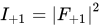 , and note that for any complex number Failed to parse (MathML with SVG or PNG fallback (recommended for modern browsers and accessibility tools): Invalid response ("Math extension cannot connect to Restbase.") from server "https://wikimedia.org/api/rest_v1/":): {\displaystyle c}
, it is true that Failed to parse (MathML with SVG or PNG fallback (recommended for modern browsers and accessibility tools): Invalid response ("Math extension cannot connect to Restbase.") from server "https://wikimedia.org/api/rest_v1/":): {\displaystyle c+c^*=2 \mathrm{Re}[c]}
. Thus:
, and note that for any complex number Failed to parse (MathML with SVG or PNG fallback (recommended for modern browsers and accessibility tools): Invalid response ("Math extension cannot connect to Restbase.") from server "https://wikimedia.org/api/rest_v1/":): {\displaystyle c}
, it is true that Failed to parse (MathML with SVG or PNG fallback (recommended for modern browsers and accessibility tools): Invalid response ("Math extension cannot connect to Restbase.") from server "https://wikimedia.org/api/rest_v1/":): {\displaystyle c+c^*=2 \mathrm{Re}[c]}
. Thus:
![{\displaystyle {\begin{aligned}I_{d}(q_{z})=\,\,&|T_{i}T_{f}|^{2}I_{+1}+|T_{i}R_{f}|^{2}I_{-2}+|R_{i}T_{f}|^{2}|I_{+2}+|R_{i}R_{f}|^{2}I_{-1}\\&+2|T_{i}|^{2}\mathrm {Re} [T_{f}R_{f}^{*}F_{+1}F_{-2}^{*}]\\&+2|T_{f}|^{2}\mathrm {Re} [T_{i}R_{i}^{*}F_{+1}F_{+2}^{*}]\\&+2|R_{i}|^{2}\mathrm {Re} [T_{f}R_{f}^{*}F_{-1}^{*}F_{+2}]\\&+2|R_{f}|^{2}\mathrm {Re} [T_{i}R_{i}^{*}F_{-1}^{*}F_{-2}]\\&+2\mathrm {Re} [T_{i}R_{i}^{*}T_{f}R_{f}^{*}F_{+1}F_{-1}^{*}]\\&+2\mathrm {Re} [T_{i}R_{i}^{*}T_{f}^{*}R_{f}F_{+2}^{*}F_{-2}]\\=\,\,&|T_{i}T_{f}|^{2}I_{+1}+|T_{i}R_{f}|^{2}I_{-2}+|R_{i}T_{f}|^{2}|I_{+2}+|R_{i}R_{f}|^{2}I_{-1}\\&+2|T_{i}|^{2}\mathrm {Re} [T_{f}R_{f}^{*}F_{+1}F_{-2}^{*}]+2|T_{f}|^{2}\mathrm {Re} [T_{i}R_{i}^{*}F_{+1}F_{+2}^{*}]\\&+2|R_{i}|^{2}\mathrm {Re} [T_{f}R_{f}^{*}F_{-1}^{*}F_{+2}]+2|R_{f}|^{2}\mathrm {Re} [T_{i}R_{i}^{*}F_{-1}^{*}F_{-2}]\\&+2\mathrm {Re} [T_{i}R_{i}^{*}T_{f}R_{f}^{*}F_{+1}F_{-1}^{*}]+2\mathrm {Re} [T_{i}R_{i}^{*}T_{f}^{*}R_{f}F_{+2}^{*}F_{-2}]\\\end{aligned}}}](https://wikimedia.org/api/rest_v1/media/math/render/svg/4f2773d5394f3fa3aa47a4fef3426b14326280fc)
Breaking into components
The experimental data  can be broken into contributions from the transmitted channel
  and reflected channel
  :
:
![{\displaystyle {\begin{aligned}I_{d}(q_{z})&=[|T_{i}T_{f}|^{2}+|R_{i}R_{f}|^{2}]I_{R}(+Q_{z1})+[|T_{i}R_{f}|^{2}+|R_{i}T_{f}|^{2}]I_{R}(+Q_{z2})\\&=[|T_{i}T_{f}|^{2}+|R_{i}R_{f}|^{2}]I_{R}(q_{z}-\Delta q_{z,\mathrm {Tc} })+[|T_{i}R_{f}|^{2}+|R_{i}T_{f}|^{2}]I_{R}(q_{z}-\Delta q_{z,\mathrm {Rc} })\\&=[|T_{i}T_{f}|^{2}+|R_{i}R_{f}|^{2}]I_{d,\mathrm {Tc} }(q_{z})+[|T_{i}R_{f}|^{2}+|R_{i}T_{f}|^{2}]I_{d,\mathrm {Rc} }(q_{z})\\&=|Tc|^{2}I_{d,\mathrm {Tc} }(q_{z})+|Rc|^{2}I_{d,\mathrm {Rc} }(q_{z})\\\end{aligned}}}](https://wikimedia.org/api/rest_v1/media/math/render/svg/3077c848d9c21901c69720b107c0f6fffbd4e8b5)
We define the ratio between the channels to be:
Failed to parse (MathML with SVG or PNG fallback (recommended for modern browsers and accessibility tools): Invalid response ("Math extension cannot connect to Restbase.") from server "https://wikimedia.org/api/rest_v1/":): {\displaystyle \begin{align} w (q_z) & = \frac{ I_{d,\mathrm{Tc}}(q_z) }{ I_{d,\mathrm{Tc}}(q_z) + I_{d,\mathrm{Rc}}(q_z) } \end{align} }
Such that one can compute the two components from:
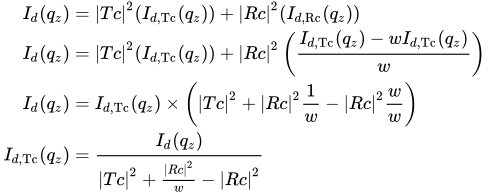
and:
Failed to parse (MathML with SVG or PNG fallback (recommended for modern browsers and accessibility tools): Invalid response ("Math extension cannot connect to Restbase.") from server "https://wikimedia.org/api/rest_v1/":): {\displaystyle \begin{align} I_{d,\mathrm{Rc}}(q_z) & = \frac{ I_d(q_{z}) - |Tc|^2 I_{d,\mathrm{Tc}}(q_z) }{|Rc|^2} \\ & = \frac{ I_d(q_{z}) }{|Rc|^2} - \frac{|Tc|^2}{|Rc|^2} I_{d,\mathrm{Tc}}(q_z) \end{align} }
or:
Failed to parse (MathML with SVG or PNG fallback (recommended for modern browsers and accessibility tools): Invalid response ("Math extension cannot connect to Restbase.") from server "https://wikimedia.org/api/rest_v1/":): {\displaystyle \begin{align} I_d(q_{z}) & = |Tc|^2 ( I_{d,\mathrm{Tc}}(q_z) ) + |Rc|^2 ( I_{d,\mathrm{Rc}}(q_z) ) \\ & = |Tc|^2 \left( \frac{w}{1-w} I_{d,\mathrm{Rc}}(q_z) \right) + |Rc|^2 ( I_{d,\mathrm{Rc}}(q_z) ) \\ I_{d,\mathrm{Rc}}(q_z) & = \frac{ I_d(q_{z}) }{|Tc|^2 \frac{w}{1-w} + |Rc|^2} \end{align} }

