|
|
| Line 35: |
Line 35: |
| | | | |
| | ===Isotropic Form Factor Intensity=== | | ===Isotropic Form Factor Intensity=== |
| − | | + | This can be computed numerically. |
| − | ::<math>
| |
| − | P_{pyr}(q) = \left\{
| |
| − |
| |
| − | \begin{array}{c l}
| |
| − | | |
| − | \frac{\Delta\rho^2 V_{pyr}^2}{ (qR)^6 } ???
| |
| − | | |
| − | & \mathrm{when} \,\, q\neq0\\
| |
| − | 4\pi \Delta\rho^2 V_{pyr}^2
| |
| − | & \mathrm{when} \,\, q=0 \\
| |
| − | \end{array}
| |
| − |
| |
| − | \right.
| |
| − | </math>
| |
| | | | |
| | ==Derivations== | | ==Derivations== |
Revision as of 17:02, 13 June 2014
Equations
For pyramid of base edge-length 2R, and height H. The angle of the pyramid walls is Failed to parse (MathML with SVG or PNG fallback (recommended for modern browsers and accessibility tools): Invalid response ("Math extension cannot connect to Restbase.") from server "https://wikimedia.org/api/rest_v1/":): {\displaystyle \alpha}
. If 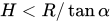 then the pyramid is truncated (flat top).
- Volume
![{\displaystyle V_{pyr}={\frac {4}{3}}\tan(\alpha )\left[R^{3}-\left(R-{\frac {H}{\tan(\alpha )}}\right)^{3}\right]}](https://wikimedia.org/api/rest_v1/media/math/render/svg/329e22d32ef40f976b9107badb40e3fc3e3f2d77)
- Projected (xy) surface area

Form Factor Amplitude
![{\displaystyle F_{pyr}(\mathbf {q} )={\frac {H}{q_{x}q_{y}}}\left({\begin{array}{l}\cos \left[(q_{x}-q_{y})R\right]K_{1}\\\,\,\,\,+\sin \left[(q_{x}-q_{y})R\right]K_{2}\\\,\,\,\,-\cos \left[(q_{x}+q_{y})R\right]K_{3}\\\,\,\,\,-\sin \left[(q_{x}+q_{y})R\right]K_{4}\end{array}}\right)}](https://wikimedia.org/api/rest_v1/media/math/render/svg/075aea2eace6490639358cec5712f8adbd4ccd16)
- where
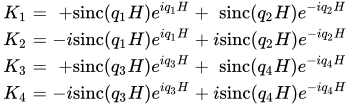
![{\displaystyle {\begin{alignedat}{2}q_{1}={\frac {1}{2}}\left[{\frac {q_{x}-q_{y}}{\tan \alpha }}+q_{z}\right]&\,\,,\,\,\,\,&q_{2}={\frac {1}{2}}\left[{\frac {q_{x}-q_{y}}{\tan \alpha }}-q_{z}\right]\\q_{3}={\frac {1}{2}}\left[{\frac {q_{x}+q_{y}}{\tan \alpha }}+q_{z}\right]&\,\,,\,\,\,\,&q_{4}={\frac {1}{2}}\left[{\frac {q_{x}+q_{y}}{\tan \alpha }}-q_{z}\right]\\\end{alignedat}}}](https://wikimedia.org/api/rest_v1/media/math/render/svg/be9d1e6bb8a6d7bed6ecc90477c85888b0dde362)
Isotropic Form Factor Intensity
This can be computed numerically.
Derivations
Form Factor
For a pyramid of base-edge-length 2R, side-angle  , truncated at H (along z axis), we note that the in-plane size of the pyramid at height z is:
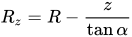
Integrating with Cartesian coordinates:
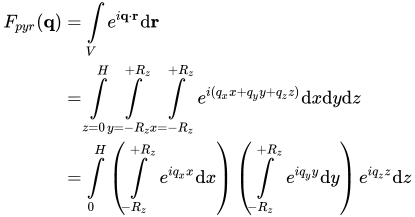
A recurring integral is (c.f. cube form factor):
![{\displaystyle {\begin{alignedat}{2}f_{x}(q_{x})&=\int _{-R_{z}}^{R_{z}}e^{iq_{x}x}\mathrm {d} x\\&=\int _{-R_{z}}^{R_{z}}\left[\cos(q_{x}x)+i\sin(q_{x}x)\right]\mathrm {d} x\\&=-{\frac {2}{q_{x}}}\sin(q_{x}R_{z})\\&=-2R_{z}\mathrm {sinc} (q_{x}R_{z})\\\end{alignedat}}}](https://wikimedia.org/api/rest_v1/media/math/render/svg/30a19f1443072196fe9b85d45cf1fdfb8305c07f)
Which gives:
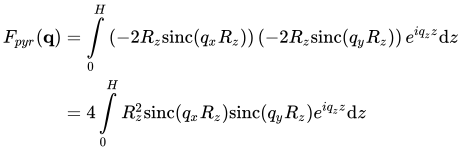
This can be simplified automated solving. For a regular pyramid, we obtain:

Form Factor near q=0
qy
When  :
:

So:
![{\displaystyle {\begin{alignedat}{2}F_{pyr}(\mathbf {q} )&={\frac {H}{q_{x}q_{y}}}\left({\begin{array}{l}\cos \left[(q_{x}-q_{y})R\right]K_{1}\\\,\,\,\,+\sin \left[(q_{x}-q_{y})R\right]K_{2}\\\,\,\,\,-\cos \left[(q_{x}+q_{y})R\right]K_{3}\\\,\,\,\,-\sin \left[(q_{x}+q_{y})R\right]K_{4}\end{array}}\right)\\&={\frac {H}{q_{x}0}}\left({\begin{array}{l}\cos \left[q_{x}R\right]K_{1}\\\,\,\,\,+\sin \left[q_{x}R\right]K_{2}\\\,\,\,\,-\cos \left[q_{x}R\right]K_{1}\\\,\,\,\,-\sin \left[q_{x}R\right]K_{2}\end{array}}\right)\\&={\frac {H}{q_{x}}}{\frac {0}{0}}\\\end{alignedat}}}](https://wikimedia.org/api/rest_v1/media/math/render/svg/5c99bb146bf5dc5a6988b4c03bcc8546ed42ac26)
qx
When  :
:
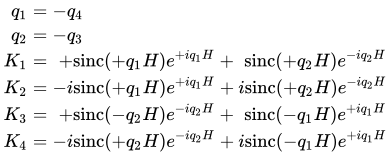
Since sinc is an even function:
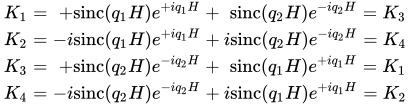
And:
![{\displaystyle {\begin{alignedat}{2}F_{pyr}(\mathbf {q} )&={\frac {H}{0q_{y}}}\left({\begin{array}{l}\cos \left[-q_{y}R\right]K_{1}\\\,\,\,\,+\sin \left[-q_{y}R\right]K_{2}\\\,\,\,\,-\cos \left[+q_{y}R\right]K_{1}\\\,\,\,\,-\sin \left[+q_{y}R\right]K_{2}\end{array}}\right)\\&={\frac {H}{0q_{y}}}\left({\begin{array}{l}\cos \left[+q_{y}R\right]K_{1}\\\,\,\,\,-\sin \left[+q_{y}R\right]K_{2}\\\,\,\,\,-\cos \left[+q_{y}R\right]K_{1}\\\,\,\,\,-\sin \left[+q_{y}R\right]K_{2}\end{array}}\right)\\&={\frac {-2H}{0q_{y}}}\sin \left(q_{y}R\right)\left[-i{\text{sinc}}(q_{1}H)e^{+iq_{1}H}+i{\text{sinc}}(q_{2}H)e^{-iq_{2}H}\right]\\&={\frac {2iH\sin(q_{y}R)}{0q_{y}}}\left[{\text{sinc}}(q_{1}H)\left(\cos(+iq_{1}H)-i\sin(+iq_{1}H)\right)-{\text{sinc}}(q_{2}H)\left(\cos(-iq_{2}H)-i\sin(-iq_{2}H)\right)\right]\\\end{alignedat}}}](https://wikimedia.org/api/rest_v1/media/math/render/svg/dc3d2bdb2594ef14026f35243a46ff76fc34e1bc)
qz
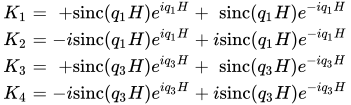
When  :
:

So:
q
When  :
:

So:
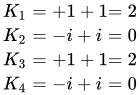
And:
![{\displaystyle F_{pyr}(\mathbf {q} )={\frac {H}{0\times 0}}\left({\begin{array}{l}\cos \left[(0)R\right]2\\\,\,\,\,+\sin \left[(0)R\right]0\\\,\,\,\,-\cos \left[(0)R\right]2\\\,\,\,\,-\sin \left[(0)R\right]0\end{array}}\right)}](https://wikimedia.org/api/rest_v1/media/math/render/svg/5ef602a9ed0b67bd7d69415cc1dfcd96c4abf913)
qx and qy
When  :
:
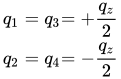
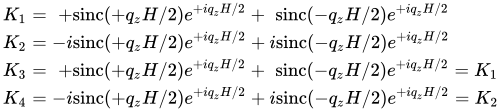
So:
![{\displaystyle {\begin{alignedat}{2}F_{pyr}(\mathbf {q} )&={\frac {H}{q_{x}q_{y}}}\left({\begin{array}{l}\cos \left[(q_{x}-q_{y})R\right]K_{1}\\\,\,\,\,+\sin \left[(q_{x}-q_{y})R\right]K_{2}\\\,\,\,\,-\cos \left[(q_{x}+q_{y})R\right]K_{1}\\\,\,\,\,-\sin \left[(q_{x}+q_{y})R\right]K_{2}\end{array}}\right)\\\end{alignedat}}}](https://wikimedia.org/api/rest_v1/media/math/render/svg/920d014c2ab1860d690b12a1d7129384a1686ea5)
To analyze the behavior in the limit of small  and
and  , we consider the limit of
  where
where  . We replace the trigonometric functions by their expansions near zero (keeping only the first two terms):
![{\displaystyle {\begin{alignedat}{2}\lim _{q\to 0}F_{pyr}(\mathbf {q} )&={\frac {H}{qq}}\left({\begin{array}{l}\cos \left[(q-q)R\right]K_{1}\\\,\,\,\,+\sin \left[(q-q)R\right]K_{2}\\\,\,\,\,-\cos \left[(q+q)R\right]K_{1}\\\,\,\,\,-\sin \left[(q+q)R\right]K_{2}\end{array}}\right)\\&={\frac {H}{q^{2}}}\left({\begin{array}{l}\left[1-{\frac {((q-q)R)^{2}}{2!}}+\cdots \right]K_{1}\\\,\,\,\,+\left[(q-q)R-{\frac {((q-q)R)^{3}}{3!}}+\cdots \right]K_{2}\\\,\,\,\,-\left[1-{\frac {((q+q)R)^{2}}{2!}}+\cdots \right]K_{1}\\\,\,\,\,-\left[(q+q)R-{\frac {((q-q)R)^{3}}{3!}}+\cdots \right]K_{2}\end{array}}\right)\\&={\frac {H}{q^{2}}}\left({\begin{array}{l}\left[1-{\frac {((q-q)R)^{2}}{2!}}-1+{\frac {((q+q)R)^{2}}{2!}}\right]K_{1}\\\,\,\,\,+\left[(q-q)R-{\frac {((q-q)R)^{3}}{3!}}-(q+q)R+{\frac {((q-q)R)^{3}}{3!}}\right]K_{2}\\\end{array}}\right)\\&={\frac {H}{q^{2}}}\left({\begin{array}{l}\left[{\frac {((2q)R)^{2}}{2!}}-{\frac {((q-q)R)^{2}}{2!}}\right]K_{1}\\\,\,\,\,+\left[(q-q)R-(2q)R\right]K_{2}\\\end{array}}\right)\\&={\frac {(2qR)^{2}}{2!}}{\frac {HK_{1}}{q^{2}}}-{\frac {((q-q)R)^{2}}{2!}}{\frac {HK_{1}}{q^{2}}}+(q-q)R{\frac {HK_{2}}{q^{2}}}-2qR{\frac {HK_{2}}{q^{2}}}\\&={\frac {4R^{2}HK_{1}}{2}}-{\frac {R^{2}HK_{1}}{2}}{\frac {(q-q)^{2}}{q^{2}}}+RHK_{2}{\frac {(q-q)}{q^{2}}}-{\frac {2RHK_{2}}{q}}\\&=2R^{2}HK_{1}\end{alignedat}}}](https://wikimedia.org/api/rest_v1/media/math/render/svg/38aade255218e520b3594125e8f520b6858df890)
Note that since  is symmetric
  . When Failed to parse (MathML with SVG or PNG fallback (recommended for modern browsers and accessibility tools): Invalid response ("Math extension cannot connect to Restbase.") from server "https://wikimedia.org/api/rest_v1/":): {\displaystyle q_x}
and Failed to parse (MathML with SVG or PNG fallback (recommended for modern browsers and accessibility tools): Invalid response ("Math extension cannot connect to Restbase.") from server "https://wikimedia.org/api/rest_v1/":): {\displaystyle q_y}
are small (but not zero and not necessarily equal), many of the above arguments still apply. It remains that
. When Failed to parse (MathML with SVG or PNG fallback (recommended for modern browsers and accessibility tools): Invalid response ("Math extension cannot connect to Restbase.") from server "https://wikimedia.org/api/rest_v1/":): {\displaystyle q_x}
and Failed to parse (MathML with SVG or PNG fallback (recommended for modern browsers and accessibility tools): Invalid response ("Math extension cannot connect to Restbase.") from server "https://wikimedia.org/api/rest_v1/":): {\displaystyle q_y}
are small (but not zero and not necessarily equal), many of the above arguments still apply. It remains that  , and:
- Failed to parse (MathML with SVG or PNG fallback (recommended for modern browsers and accessibility tools): Invalid response ("Math extension cannot connect to Restbase.") from server "https://wikimedia.org/api/rest_v1/":): {\displaystyle \begin{alignat}{2} \lim_{(q_x,q_y)\to0} F_{pyr}(\mathbf{q}) & = \frac{H K_1}{q_x q_y} \left( \cos\left[ (q_x-q_y)R \right] - \cos\left[ (q_x+q_y)R \right] \right) \\ & = \frac{H K_1}{q_x q_y} \left( \left[ 1 - \frac{ ((q_x-q_y)R)^2}{2!} + \cdots \right] - \left[ 1 - \frac{((q_x+q_y)R)^2}{2!} + \cdots \right] \right) \\ & = \frac{H K_1}{q_x q_y} \left( \frac{(q_x+q_y)^2 R^2}{2!} - \frac{(q_x-q_y)^2 R^2}{2!} \right) \\ & = \frac{H R^2 K_1}{2 q_x q_y} \left( (q_x+q_y)^2 - (q_x-q_y)^2 \right) \\ \end{alignat} }
Isotropic Form Factor Intensity
To average over all possible orientations, we note:
- Failed to parse (MathML with SVG or PNG fallback (recommended for modern browsers and accessibility tools): Invalid response ("Math extension cannot connect to Restbase.") from server "https://wikimedia.org/api/rest_v1/":): {\displaystyle \mathbf{q}=(q_x,q_y,q_z)=(-q\sin\theta\cos\phi,q\sin\theta\sin\phi,q\cos\theta)}
and use:
![{\displaystyle {\begin{alignedat}{2}P_{pyr}(q)&=\int \limits _{S}|F_{pyr}(\mathbf {q} )|^{2}\mathrm {d} \mathbf {s} \\&=\int _{\phi =0}^{2\pi }\int _{\theta =0}^{\pi }\left|{\frac {H}{q_{x}q_{y}}}\left({\begin{array}{l}\cos \left[(q_{x}-q_{y})R\right]K_{1}\\\,\,\,\,+\sin \left[(q_{x}-q_{y})R\right]K_{2}\\\,\,\,\,-\cos \left[(q_{x}+q_{y})R\right]K_{3}\\\,\,\,\,-\sin \left[(q_{x}+q_{y})R\right]K_{4}\end{array}}\right)\right|^{2}\sin \theta \mathrm {d} \theta \mathrm {d} \phi \\&={\frac {H^{2}}{q^{2}}}\int _{0}^{2\pi }\int _{0}^{\pi }{\frac {1}{\sin ^{4}\theta \sin ^{2}\phi \cos ^{2}\phi }}\left|\left({\begin{array}{l}\cos \left[(q_{x}-q_{y})R\right]K_{1}\\\,\,\,\,+\sin \left[(q_{x}-q_{y})R\right]K_{2}\\\,\,\,\,-\cos \left[(q_{x}+q_{y})R\right]K_{3}\\\,\,\,\,-\sin \left[(q_{x}+q_{y})R\right]K_{4}\end{array}}\right)\right|^{2}\sin \theta \mathrm {d} \theta \mathrm {d} \phi \\\end{alignedat}}}](https://wikimedia.org/api/rest_v1/media/math/render/svg/d26516cff0742b823a2c56deeec42327b549faaa)
Regular Pyramid
A regular pyramid (half of an octahedron) has faces that are equilateral triangles (each vertex is 60°). The 'corner-to-edge' distance along each triangular face is then:
- Failed to parse (MathML with SVG or PNG fallback (recommended for modern browsers and accessibility tools): Invalid response ("Math extension cannot connect to Restbase.") from server "https://wikimedia.org/api/rest_v1/":): {\displaystyle d_{face,c-e} = R \tan(60^{\circ}) = \sqrt{3} R}
This makes the height:
- Failed to parse (MathML with SVG or PNG fallback (recommended for modern browsers and accessibility tools): Invalid response ("Math extension cannot connect to Restbase.") from server "https://wikimedia.org/api/rest_v1/":): {\displaystyle \begin{alignat}{2} (d_{face,c-e})^2 & = (H)^2 + (R)^2 \\ H^2 & = (d_{face,c-e})^2 - (R)^2\\ H & = \sqrt{ (\sqrt{3} R)^2 - (R)^2 }\\ & = \sqrt{ 3 R^2 - R^2 }\\ & = \sqrt{ 2 } R \\ \end{alignat} }
So that the pyramid face angle, Failed to parse (MathML with SVG or PNG fallback (recommended for modern browsers and accessibility tools): Invalid response ("Math extension cannot connect to Restbase.") from server "https://wikimedia.org/api/rest_v1/":): {\displaystyle \alpha}
is:
- Failed to parse (MathML with SVG or PNG fallback (recommended for modern browsers and accessibility tools): Invalid response ("Math extension cannot connect to Restbase.") from server "https://wikimedia.org/api/rest_v1/":): {\displaystyle \begin{alignat}{2} \tan(\alpha) & = \frac{ H }{ R } \\ \alpha & = \arctan \left( \frac{\sqrt{ 2 } R}{R} \right) \\ & = \arctan( \sqrt{2} ) \\ & \approx 0.9553 \\ & \approx 54.75^{\circ} \end{alignat} }
The square base of the pyramid has edges of length 2R. The distance from the center of the square to any corner is H, such that:
- Failed to parse (MathML with SVG or PNG fallback (recommended for modern browsers and accessibility tools): Invalid response ("Math extension cannot connect to Restbase.") from server "https://wikimedia.org/api/rest_v1/":): {\displaystyle \begin{alignat}{2} \cos(45^{\circ}) & = \frac{R}{H} \\ H & = \frac{R}{ 1/\sqrt{2} } \\ & = \sqrt{2} R \end{alignat} }
Surface Area
For a non-truncated, regular pyramid, each face is an equilateral triangle (each vertex is 60°). So each face:
- Failed to parse (MathML with SVG or PNG fallback (recommended for modern browsers and accessibility tools): Invalid response ("Math extension cannot connect to Restbase.") from server "https://wikimedia.org/api/rest_v1/":): {\displaystyle \begin{alignat}{2} S_{face} & = 2 \times \left( \frac{ R R \tan(60^{\circ}) }{2} \right) \\ & = R^2 \sqrt{3} \end{alignat} }
The base is simply:
- Failed to parse (MathML with SVG or PNG fallback (recommended for modern browsers and accessibility tools): Invalid response ("Math extension cannot connect to Restbase.") from server "https://wikimedia.org/api/rest_v1/":): {\displaystyle \begin{alignat}{2} S_{base} & = 2 R \times 2 R \\ & = 4 R^2 \end{alignat} }
Total:
- Failed to parse (MathML with SVG or PNG fallback (recommended for modern browsers and accessibility tools): Invalid response ("Math extension cannot connect to Restbase.") from server "https://wikimedia.org/api/rest_v1/":): {\displaystyle \begin{alignat}{2} S_{pyr} & = 4 \times R^2 \sqrt{3} + 4 R^2 \\ & = 4(1 + \sqrt{3}) R^2 \end{alignat} }
Volume
For a regular pyramid, the height Failed to parse (MathML with SVG or PNG fallback (recommended for modern browsers and accessibility tools): Invalid response ("Math extension cannot connect to Restbase.") from server "https://wikimedia.org/api/rest_v1/":): {\displaystyle H=\sqrt{2}R}
and Failed to parse (MathML with SVG or PNG fallback (recommended for modern browsers and accessibility tools): Invalid response ("Math extension cannot connect to Restbase.") from server "https://wikimedia.org/api/rest_v1/":): {\displaystyle \tan(\alpha)=H/R = \sqrt{2}}
:
- Failed to parse (MathML with SVG or PNG fallback (recommended for modern browsers and accessibility tools): Invalid response ("Math extension cannot connect to Restbase.") from server "https://wikimedia.org/api/rest_v1/":): {\displaystyle \begin{alignat}{2} V_{pyr} & = \frac{4}{3} \tan (\alpha) \left[ R^3 - \left( R - \frac{H}{ \tan (\alpha)} \right)^3 \right] \\ & = \frac{4}{3} \sqrt{2} \left[ R^3 - \left( R - \frac{ \sqrt{2} R }{ \sqrt{2}} \right)^3 \right] \\ & = \frac{4\sqrt{2}}{3} R^3 \\ \end{alignat} }

