Lattice:Packing fraction
Revision as of 17:43, 3 June 2014 by KevinYager (talk | contribs) (Created page with "The '''packing fraction''' (or particle volume fraction) for a lattice is given by: :<math>\phi = \frac{ N V_{\mathrm{particle}} } { v_{\mathrm{cell}} }</math> Where ''N'' is ...")
The packing fraction (or particle volume fraction) for a lattice is given by:
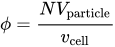
Where N is the number of particles per unit cell (which has volume ). For a sphere, the volume is so:

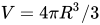
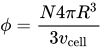
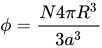
For a cubic cell:
Examples
For a FCC lattice, the packing fraction is 0.740:
- Nearest-neighbor distance:
- Assuming spherical particles of radius R:
- Particle volume fraction:
- Maximum volume fraction: when
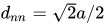


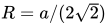
For a BCC lattice, the packing fraction is 0.680:
- Nearest-neighbor distance:
- Assuming spherical particles of radius R:
- Particle volume fraction:
- Maximum volume fraction: when
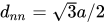
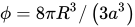


For a diamond lattice, the packing fraction is 0.340:
- Nearest-neighbor distance:
- Assuming spherical particles of radius R:
- Particle volume fraction:
- Maximum volume fraction: when





