Form Factor:Pyramid
Contents
Equations
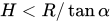
For pyramid of base edge-length 2R, and height H. The angle of the pyramid walls is Failed to parse (MathML with SVG or PNG fallback (recommended for modern browsers and accessibility tools): Invalid response ("Math extension cannot connect to Restbase.") from server "https://wikimedia.org/api/rest_v1/":): {\displaystyle \alpha} . If then the pyramid is truncated (flat top).
- Volume Failed to parse (MathML with SVG or PNG fallback (recommended for modern browsers and accessibility tools): Invalid response ("Math extension cannot connect to Restbase.") from server "https://wikimedia.org/api/rest_v1/":): {\displaystyle V_{pyr} = \frac{4}{3} \tan (\alpha) \left[ R^3 - \left( R - \frac{H}{ \tan (\alpha)} \right)^3 \right]}
- Projected (xy) surface area

Form Factor Amplitude
- Failed to parse (MathML with SVG or PNG fallback (recommended for modern browsers and accessibility tools): Invalid response ("Math extension cannot connect to Restbase.") from server "https://wikimedia.org/api/rest_v1/":): {\displaystyle F_{pyr}(\mathbf{q}) = \frac{H}{q_x q_y} \left( \begin{array}{l} \cos\left[ (q_x-q_y)R \right] K_1 \\ \,\,\,\, + \sin\left[ (q_x-q_y)R \right] K_2 \\ \,\,\,\, - \cos\left[ (q_x+q_y)R \right] K_3 \\ \,\,\,\, - \sin\left[ (q_x+q_y)R \right] K_4 \end{array} \right) }
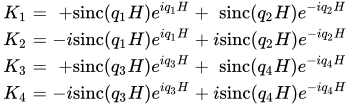
- where
- Failed to parse (MathML with SVG or PNG fallback (recommended for modern browsers and accessibility tools): Invalid response ("Math extension cannot connect to Restbase.") from server "https://wikimedia.org/api/rest_v1/":): {\displaystyle \begin{alignat}{2} q_1 = \frac{1}{2}\left[ \frac{q_x - q_y}{\tan\alpha} + q_z \right] & \,\, , \,\,\,\, & q_2 = \frac{1}{2}\left[ \frac{q_x - q_y}{\tan\alpha} - q_z \right] \\ q_3 = \frac{1}{2}\left[ \frac{q_x + q_y}{\tan\alpha} + q_z \right] & \,\, , \,\,\,\, & q_4 = \frac{1}{2}\left[ \frac{q_x + q_y}{\tan\alpha} - q_z \right] \\ \end{alignat} }
Isotropic Form Factor Intensity
Derivations
Form Factor
For a pyramid of base-edge-length 2R, side-angle Failed to parse (MathML with SVG or PNG fallback (recommended for modern browsers and accessibility tools): Invalid response ("Math extension cannot connect to Restbase.") from server "https://wikimedia.org/api/rest_v1/":): {\displaystyle \alpha} , truncated at H (along z axis), we note that the in-plane size of the pyramid at height z is:
- Failed to parse (MathML with SVG or PNG fallback (recommended for modern browsers and accessibility tools): Invalid response ("Math extension cannot connect to Restbase.") from server "https://wikimedia.org/api/rest_v1/":): {\displaystyle R_z = R - \frac{ z }{ \tan \alpha }}
Integrating with Cartesian coordinates:
- Failed to parse (MathML with SVG or PNG fallback (recommended for modern browsers and accessibility tools): Invalid response ("Math extension cannot connect to Restbase.") from server "https://wikimedia.org/api/rest_v1/":): {\displaystyle \begin{alignat}{2} F_{pyr}(\mathbf{q}) & = \int\limits_V e^{i \mathbf{q} \cdot \mathbf{r} } \mathrm{d}\mathbf{r} \\ & = \int\limits_{z=0}^{H}\int\limits_{y=-R_z}^{+R_z}\int\limits_{x=-R_z}^{+R_z} e^{i (q_x x + q_y y + q_z z) } \mathrm{d}x \mathrm{d}y \mathrm{d}z \\ & = \int\limits_{0}^{H} \left( \int\limits_{-R_z}^{+R_z} e^{i q_x x} \mathrm{d}x \right) \left( \int\limits_{-R_z}^{+R_z} e^{i q_y y} \mathrm{d}y \right) e^{i q_z z} \mathrm{d}z \end{alignat} }
A recurring integral is (c.f. cube form factor):
- Failed to parse (MathML with SVG or PNG fallback (recommended for modern browsers and accessibility tools): Invalid response ("Math extension cannot connect to Restbase.") from server "https://wikimedia.org/api/rest_v1/":): {\displaystyle \begin{alignat}{2} f_{x}(q_x) & = \int_{-R_z}^{R_z} e^{i q_x x} \mathrm{d}x \\ & = \int_{-R_z}^{R_z} \left[\cos(q_x x) + i \sin(q_x x)\right] \mathrm{d}x \\ & = -\frac{2}{q_x}\sin(q_x R_z) \\ & = -2 R_z\mathrm{sinc}(q_x R_z) \\ \end{alignat} }
Which gives:
- Failed to parse (MathML with SVG or PNG fallback (recommended for modern browsers and accessibility tools): Invalid response ("Math extension cannot connect to Restbase.") from server "https://wikimedia.org/api/rest_v1/":): {\displaystyle \begin{alignat}{2} F_{pyr}(\mathbf{q}) & = \int\limits_{0}^{H} \left( -2 R_z\mathrm{sinc}(q_x R_z) \right) \left( -2 R_z\mathrm{sinc}(q_y R_z) \right) e^{i q_z z} \mathrm{d}z \\ & = 4 \int\limits_{0}^{H} R_z^2 \mathrm{sinc}(q_x R_z) \mathrm{sinc}(q_y R_z) e^{i q_z z} \mathrm{d}z \end{alignat} }
This can be simplified automated solving. For a regular pyramid, we obtain:
- Failed to parse (MathML with SVG or PNG fallback (recommended for modern browsers and accessibility tools): Invalid response ("Math extension cannot connect to Restbase.") from server "https://wikimedia.org/api/rest_v1/":): {\displaystyle \begin{alignat}{2} F_{pyr}(\mathbf{q}) & = \frac{ 4 \sqrt{2} }{q_x q_y} \frac{ \left( \begin{array}{l} -q_y \left(-q_x^2+q_y^2-2 q_z^2\right) \cos(q_y R) \sin(q_x R) \\ \,\,\,\, -q_x \cos(q_x R) \left(2 i \sqrt{2} q_y q_z \cos(q_y R) +\left(q_x^2-q_y^2-2 q_z^2\right) \sin(q_y R)\right) \\ \,\,\,\, +i \sqrt{2} q_z \left(2 e^{i \sqrt{2} q_z R} q_x q_y-\left(q_x^2+q_y^2-2 q_z^2\right) \sin(q_x R) \sin(q_y R)\right) \end{array} \right) } { q_x^4 + (q_y^2 - 2 q_z^2)^2 - 2 q_x^2 (q_y^2 + 2 q_z^2) } \end{alignat} }
Form Factor near q=0
qy
When Failed to parse (MathML with SVG or PNG fallback (recommended for modern browsers and accessibility tools): Invalid response ("Math extension cannot connect to Restbase.") from server "https://wikimedia.org/api/rest_v1/":): {\displaystyle q_y=0} :
- Failed to parse (MathML with SVG or PNG fallback (recommended for modern browsers and accessibility tools): Invalid response ("Math extension cannot connect to Restbase.") from server "https://wikimedia.org/api/rest_v1/":): {\displaystyle \begin{alignat}{2} q_1 & = q_3 \\ q_2 & = q_4 \\ K_1 & = K_3 \\ K_2 & = K_4 \\ \end{alignat} }
So:
- Failed to parse (MathML with SVG or PNG fallback (recommended for modern browsers and accessibility tools): Invalid response ("Math extension cannot connect to Restbase.") from server "https://wikimedia.org/api/rest_v1/":): {\displaystyle \begin{alignat}{2} F_{pyr}(\mathbf{q}) & = \frac{H}{q_x q_y} \left( \begin{array}{l} \cos\left[ (q_x-q_y)R \right] K_1 \\ \,\,\,\, + \sin\left[ (q_x-q_y)R \right] K_2 \\ \,\,\,\, - \cos\left[ (q_x+q_y)R \right] K_3 \\ \,\,\,\, - \sin\left[ (q_x+q_y)R \right] K_4 \end{array}\right) \\ & = \frac{H}{q_x 0} \left( \begin{array}{l} \cos\left[ q_x R \right] K_1 \\ \,\,\,\, + \sin\left[ q_x R \right] K_2 \\ \,\,\,\, - \cos\left[ q_x R \right] K_1 \\ \,\,\,\, - \sin\left[ q_x R \right] K_2 \end{array}\right) \\ & = \frac{H}{q_x } \frac{0}{0} \\ \end{alignat} }
qx
When Failed to parse (MathML with SVG or PNG fallback (recommended for modern browsers and accessibility tools): Invalid response ("Math extension cannot connect to Restbase.") from server "https://wikimedia.org/api/rest_v1/":): {\displaystyle q_x=0} :
- Failed to parse (MathML with SVG or PNG fallback (recommended for modern browsers and accessibility tools): Invalid response ("Math extension cannot connect to Restbase.") from server "https://wikimedia.org/api/rest_v1/":): {\displaystyle \begin{alignat}{2} q_1 & = - q_4 \\ q_2 & = - q_3 \\ K_1 & = \,\, +\text{sinc}(+q_1 H) e^{+i q_1 H} + \,\, \text{sinc}(+q_2 H)e^{-iq_2 H} \\ K_2 & = -i\text{sinc}(+q_1 H) e^{+i q_1 H} + i\text{sinc}(+q_2 H)e^{-iq_2 H} \\ K_3 & = \,\, +\text{sinc}(-q_2 H) e^{-i q_2 H} + \,\, \text{sinc}(-q_1 H)e^{+iq_1 H} \\ K_4 & = -i\text{sinc}(+q_2 H) e^{-i q_2 H} + i\text{sinc}(-q_1 H)e^{+iq_1 H} \end{alignat} }
Since sinc is an even function:
- Failed to parse (MathML with SVG or PNG fallback (recommended for modern browsers and accessibility tools): Invalid response ("Math extension cannot connect to Restbase.") from server "https://wikimedia.org/api/rest_v1/":): {\displaystyle \begin{alignat}{2} K_1 & = \,\, +\text{sinc}(q_1 H) e^{+i q_1 H} + \,\, \text{sinc}(q_2 H)e^{-iq_2 H} = K_3 \\ K_2 & = -i\text{sinc}(q_1 H) e^{+i q_1 H} + i\text{sinc}(q_2 H)e^{-iq_2 H} = K_4 \\ K_3 & = \,\, +\text{sinc}(q_2 H) e^{-i q_2 H} + \,\, \text{sinc}(q_1 H)e^{+iq_1 H} = K_1 \\ K_4 & = -i\text{sinc}(q_2 H) e^{-i q_2 H} + i\text{sinc}(q_1 H)e^{+iq_1 H} = K_2 \end{alignat} }
And:
- Failed to parse (MathML with SVG or PNG fallback (recommended for modern browsers and accessibility tools): Invalid response ("Math extension cannot connect to Restbase.") from server "https://wikimedia.org/api/rest_v1/":): {\displaystyle \begin{alignat}{2} F_{pyr}(\mathbf{q}) & = \frac{H}{0 q_y} \left( \begin{array}{l} \cos\left[ -q_yR \right] K_1 \\ \,\,\,\, + \sin\left[ -q_yR \right] K_2 \\ \,\,\,\, - \cos\left[ +q_yR \right] K_1 \\ \,\,\,\, - \sin\left[ +q_yR \right] K_2 \end{array}\right) \\ & = \frac{H}{0 q_y} \left( \begin{array}{l} \cos\left[ +q_yR \right] K_1 \\ \,\,\,\, - \sin\left[ +q_yR \right] K_2 \\ \,\,\,\, - \cos\left[ +q_yR \right] K_1 \\ \,\,\,\, - \sin\left[ +q_yR \right] K_2 \end{array}\right) \\ & = \frac{-2 H}{0 q_y} \sin\left( q_yR \right) \left[ -i \text{sinc}(q_1 H) e^{+i q_1 H} + i\text{sinc}(q_2 H)e^{-iq_2 H} \right] \\ & = \frac{2 i H \sin( q_y R )}{0 q_y} \left[ \text{sinc}(q_1 H) \left( \cos(+i q_1 H) - i \sin(+i q_1 H) \right) - \text{sinc}(q_2 H) \left( \cos(-i q_2 H) - i \sin(-i q_2 H) \right) \right] \\ \end{alignat} }
qz
When Failed to parse (MathML with SVG or PNG fallback (recommended for modern browsers and accessibility tools): Invalid response ("Math extension cannot connect to Restbase.") from server "https://wikimedia.org/api/rest_v1/":): {\displaystyle q_z=0} :
- Failed to parse (MathML with SVG or PNG fallback (recommended for modern browsers and accessibility tools): Invalid response ("Math extension cannot connect to Restbase.") from server "https://wikimedia.org/api/rest_v1/":): {\displaystyle \begin{alignat}{2} q_1 & = q_2 \\ q_3 & = q_4 \\ \end{alignat} }
So:
- Failed to parse (MathML with SVG or PNG fallback (recommended for modern browsers and accessibility tools): Invalid response ("Math extension cannot connect to Restbase.") from server "https://wikimedia.org/api/rest_v1/":): {\displaystyle \begin{alignat}{2} K_1 & = \,\, +\text{sinc}(q_1 H) e^{i q_1 H} + \,\, \text{sinc}(q_1 H)e^{-iq_1 H} \\ K_2 & = -i\text{sinc}(q_1 H) e^{i q_1 H} + i\text{sinc}(q_1 H)e^{-iq_1 H} \\ K_3 & = \,\, +\text{sinc}(q_3 H) e^{i q_3 H} + \,\, \text{sinc}(q_3 H)e^{-iq_3 H} \\ K_4 & = -i\text{sinc}(q_3 H) e^{i q_3 H} + i\text{sinc}(q_3 H)e^{-iq_3 H} \end{alignat} }
q
When Failed to parse (MathML with SVG or PNG fallback (recommended for modern browsers and accessibility tools): Invalid response ("Math extension cannot connect to Restbase.") from server "https://wikimedia.org/api/rest_v1/":): {\displaystyle q=0} :
- Failed to parse (MathML with SVG or PNG fallback (recommended for modern browsers and accessibility tools): Invalid response ("Math extension cannot connect to Restbase.") from server "https://wikimedia.org/api/rest_v1/":): {\displaystyle \begin{alignat}{2} q_1 & = q_2 = q_3 = q_4 = 0\\ \end{alignat} }
So:
- Failed to parse (MathML with SVG or PNG fallback (recommended for modern browsers and accessibility tools): Invalid response ("Math extension cannot connect to Restbase.") from server "https://wikimedia.org/api/rest_v1/":): {\displaystyle \begin{alignat}{3} K_1 & = +1+1& = 2 \\ K_2 & = -i + i & = 0 \\ K_3 & = +1 + 1 & = 2 \\ K_4 & = -i + i & = 0 \end{alignat} }
And:
- Failed to parse (MathML with SVG or PNG fallback (recommended for modern browsers and accessibility tools): Invalid response ("Math extension cannot connect to Restbase.") from server "https://wikimedia.org/api/rest_v1/":): {\displaystyle F_{pyr}(\mathbf{q}) = \frac{H}{0 \times 0} \left( \begin{array}{l} \cos\left[ (0)R \right] 2 \\ \,\,\,\, + \sin\left[ (0)R \right] 0 \\ \,\,\,\, - \cos\left[ (0)R \right] 2 \\ \,\,\,\, - \sin\left[ (0)R \right] 0 \end{array} \right) }
qx and qy
When Failed to parse (MathML with SVG or PNG fallback (recommended for modern browsers and accessibility tools): Invalid response ("Math extension cannot connect to Restbase.") from server "https://wikimedia.org/api/rest_v1/":): {\displaystyle q_x=q_y=0} :
- Failed to parse (MathML with SVG or PNG fallback (recommended for modern browsers and accessibility tools): Invalid response ("Math extension cannot connect to Restbase.") from server "https://wikimedia.org/api/rest_v1/":): {\displaystyle \begin{alignat}{3} q_1 & = q_3 & = +\frac{q_z}{2} \\ q_2 & = q_4 & = -\frac{q_z}{2} \\ \end{alignat} }
- Failed to parse (MathML with SVG or PNG fallback (recommended for modern browsers and accessibility tools): Invalid response ("Math extension cannot connect to Restbase.") from server "https://wikimedia.org/api/rest_v1/":): {\displaystyle \begin{alignat}{2} K_1 & = \,\, +\text{sinc}(+q_z H/2) e^{+i q_z H/2} + \,\, \text{sinc}(-q_z H/2)e^{+iq_z H/2} \\ K_2 & = -i\text{sinc}(+q_z H/2) e^{+i q_z H/2} + i\text{sinc}(-q_z H/2)e^{+iq_z H/2} \\ K_3 & = \,\, +\text{sinc}(+q_z H/2) e^{+i q_z H/2} + \,\, \text{sinc}(-q_z H/2)e^{+iq_z H/2} = K_1 \\ K_4 & = -i\text{sinc}(+q_z H/2) e^{+i q_z H/2} + i\text{sinc}(-q_z H/2)e^{+iq_z H/2} = K_2 \end{alignat} }
So:
- Failed to parse (MathML with SVG or PNG fallback (recommended for modern browsers and accessibility tools): Invalid response ("Math extension cannot connect to Restbase.") from server "https://wikimedia.org/api/rest_v1/":): {\displaystyle \begin{alignat}{2} F_{pyr}(\mathbf{q}) & = \frac{H}{q_x q_y} \left( \begin{array}{l} \cos\left[ (q_x-q_y)R \right] K_1 \\ \,\,\,\, + \sin\left[ (q_x-q_y)R \right] K_2 \\ \,\,\,\, - \cos\left[ (q_x+q_y)R \right] K_1 \\ \,\,\,\, - \sin\left[ (q_x+q_y)R \right] K_2 \end{array} \right) \\ \end{alignat} }
To analyze the behavior in the limit of small Failed to parse (MathML with SVG or PNG fallback (recommended for modern browsers and accessibility tools): Invalid response ("Math extension cannot connect to Restbase.") from server "https://wikimedia.org/api/rest_v1/":): {\displaystyle q_x} and Failed to parse (MathML with SVG or PNG fallback (recommended for modern browsers and accessibility tools): Invalid response ("Math extension cannot connect to Restbase.") from server "https://wikimedia.org/api/rest_v1/":): {\displaystyle q_y} , we consider the limit of Failed to parse (MathML with SVG or PNG fallback (recommended for modern browsers and accessibility tools): Invalid response ("Math extension cannot connect to Restbase.") from server "https://wikimedia.org/api/rest_v1/":): {\displaystyle q\to0} where Failed to parse (MathML with SVG or PNG fallback (recommended for modern browsers and accessibility tools): Invalid response ("Math extension cannot connect to Restbase.") from server "https://wikimedia.org/api/rest_v1/":): {\displaystyle q_x=q_y=q} . We replace the trigonometric functions by their expansions near zero (keeping only the first two terms):
- Failed to parse (MathML with SVG or PNG fallback (recommended for modern browsers and accessibility tools): Invalid response ("Math extension cannot connect to Restbase.") from server "https://wikimedia.org/api/rest_v1/":): {\displaystyle \begin{alignat}{2} \lim_{q\to0} F_{pyr}(\mathbf{q}) & = \frac{H}{q q} \left( \begin{array}{l} \cos\left[ (q-q)R \right] K_1 \\ \,\,\,\, + \sin\left[ (q-q)R \right] K_2 \\ \,\,\,\, - \cos\left[ (q+q)R \right] K_1 \\ \,\,\,\, - \sin\left[ (q+q)R \right] K_2 \end{array} \right) \\ & = \frac{H}{q^2} \left( \begin{array}{l} \left[ 1 - \frac{ ((q-q)R)^2 }{2!} + \cdots \right] K_1 \\ \,\,\,\, + \left[ (q-q)R - \frac{((q-q)R)^3}{3!} + \cdots \right] K_2 \\ \,\,\,\, - \left[ 1 - \frac{ ((q+q)R)^2}{2!} + \cdots \right] K_1 \\ \,\,\,\, - \left[ (q+q)R - \frac{((q-q)R)^3}{3!} + \cdots \right] K_2 \end{array} \right) \\ & = \frac{H}{q^2} \left( \begin{array}{l} \left[ 1 - \frac{ ((q-q)R)^2 }{2!} - 1 + \frac{ ((q+q)R)^2}{2!} \right] K_1 \\ \,\,\,\, + \left[ (q-q)R - \frac{((q-q)R)^3}{3!} - (q+q)R + \frac{((q-q)R)^3}{3!}\right] K_2 \\ \end{array} \right) \\ & = \frac{H}{q^2} \left( \begin{array}{l} \left[ \frac{ ((2q)R)^2}{2!} - \frac{ ((q-q)R)^2 }{2!} \right] K_1 \\ \,\,\,\, + \left[ (q-q)R - (2q)R \right] K_2 \\ \end{array} \right) \\ & = \frac{ (2qR)^2}{2!}\frac{H K_1}{q^2} - \frac{ ((q-q)R)^2 }{2!}\frac{H K_1}{q^2} + (q-q)R \frac{H K_2}{q^2} - 2qR \frac{H K_2}{q^2} \\ & = \frac{ 4R^2 H K_1}{2} - \frac{ R^2 H K_1}{2}\frac{(q-q)^2}{q^2} + R H K_2\frac{(q-q)}{q^2} - \frac{2 R H K_2}{q} \\ & = 2R^2 H K_1 \end{alignat} }
Note that since Failed to parse (MathML with SVG or PNG fallback (recommended for modern browsers and accessibility tools): Invalid response ("Math extension cannot connect to Restbase.") from server "https://wikimedia.org/api/rest_v1/":): {\displaystyle \mathrm{sinc}} is symmetric Failed to parse (MathML with SVG or PNG fallback (recommended for modern browsers and accessibility tools): Invalid response ("Math extension cannot connect to Restbase.") from server "https://wikimedia.org/api/rest_v1/":): {\displaystyle K_2=K_4=0} . When Failed to parse (MathML with SVG or PNG fallback (recommended for modern browsers and accessibility tools): Invalid response ("Math extension cannot connect to Restbase.") from server "https://wikimedia.org/api/rest_v1/":): {\displaystyle q_x} and Failed to parse (MathML with SVG or PNG fallback (recommended for modern browsers and accessibility tools): Invalid response ("Math extension cannot connect to Restbase.") from server "https://wikimedia.org/api/rest_v1/":): {\displaystyle q_y} are small (but not zero and not necessarily equal), many of the above arguments still apply. It remains that Failed to parse (MathML with SVG or PNG fallback (recommended for modern browsers and accessibility tools): Invalid response ("Math extension cannot connect to Restbase.") from server "https://wikimedia.org/api/rest_v1/":): {\displaystyle K_2 \approx K_4 \approx 0} , and:
- Failed to parse (MathML with SVG or PNG fallback (recommended for modern browsers and accessibility tools): Invalid response ("Math extension cannot connect to Restbase.") from server "https://wikimedia.org/api/rest_v1/":): {\displaystyle \begin{alignat}{2} \lim_{(q_x,q_y)\to0} F_{pyr}(\mathbf{q}) & = \frac{H K_1}{q_x q_y} \left( \cos\left[ (q_x-q_y)R \right] - \cos\left[ (q_x+q_y)R \right] \right) \\ & = \frac{H K_1}{q_x q_y} \left( \left[ 1 - \frac{ ((q_x-q_y)R)^2}{2!} + \cdots \right] - \left[ 1 - \frac{((q_x+q_y)R)^2}{2!} + \cdots \right] \right) \\ & = \frac{H K_1}{q_x q_y} \left( \frac{(q_x+q_y)^2 R^2}{2!} - \frac{(q_x-q_y)^2 R^2}{2!} \right) \\ & = \frac{H R^2 K_1}{2 q_x q_y} \left( (q_x+q_y)^2 - (q_x-q_y)^2 \right) \\ \end{alignat} }
Isotropic Form Factor Intensity
To average over all possible orientations, we note:
- Failed to parse (MathML with SVG or PNG fallback (recommended for modern browsers and accessibility tools): Invalid response ("Math extension cannot connect to Restbase.") from server "https://wikimedia.org/api/rest_v1/":): {\displaystyle \mathbf{q}=(q_x,q_y,q_z)=(-q\sin\theta\cos\phi,q\sin\theta\sin\phi,q\cos\theta)}
and use:
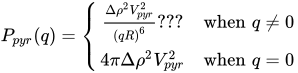
- Failed to parse (MathML with SVG or PNG fallback (recommended for modern browsers and accessibility tools): Invalid response ("Math extension cannot connect to Restbase.") from server "https://wikimedia.org/api/rest_v1/":): {\displaystyle \begin{alignat}{2} P_{pyr}(q) & = \int\limits_{S} | F_{pyr}(\mathbf{q}) |^2 \mathrm{d}\mathbf{s} \\ & = \int_{\phi=0}^{2\pi}\int_{\theta=0}^{\pi} \left| \frac{H}{q_x q_y} \left( \begin{array}{l} \cos\left[ (q_x-q_y)R \right] K_1 \\ \,\,\,\, + \sin\left[ (q_x-q_y)R \right] K_2 \\ \,\,\,\, - \cos\left[ (q_x+q_y)R \right] K_3 \\ \,\,\,\, - \sin\left[ (q_x+q_y)R \right] K_4 \end{array} \right) \right|^2 \sin\theta\mathrm{d}\theta\mathrm{d}\phi \\ & = \frac{H^2}{q^2} \int_{0}^{2\pi}\int_{0}^{\pi} \frac{1}{\sin^4\theta \sin^2\phi\cos^2\phi} \left| \left( \begin{array}{l} \cos\left[ (q_x-q_y)R \right] K_1 \\ \,\,\,\, + \sin\left[ (q_x-q_y)R \right] K_2 \\ \,\,\,\, - \cos\left[ (q_x+q_y)R \right] K_3 \\ \,\,\,\, - \sin\left[ (q_x+q_y)R \right] K_4 \end{array} \right) \right|^2 \sin\theta\mathrm{d}\theta\mathrm{d}\phi \\ \end{alignat} }

