Lattice:Diamond
The diamond lattice, which consists of tetrahedrally-arranged atoms/particles, has simple cubic symmetry.

Along an appropriate axis, the lattice has six-fold symmetry (hexagonal).
Contents
Canonical Diamond
A canonical diamond lattice (single atom/particle type arranged as shown above) has symmetry Fd3m. The atoms occupy the positions (0,0,0;1/4,1/4,1/4)+face-centering.
Symmetry
- Crystal Family: Cubic
- Crystal System: Cubic
- Bravais Lattice: F (fcc)
- Crystal class: Hexoctahedral
- Point Group: d3m
- Space Group: Fd3m
- Particles per unit cell:
- Volume of unit cell:
- Dimensionality:
- Projected d-dimensional volume:
- Solid angle:
- Nearest-neighbor distance:
- Assuming spherical particles of radius R:
- Particle volume fraction:
- Maximum volume fraction: when






Structure
The lattice may be thought of as two interpenetrating FCC lattices.
Particle Positions
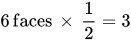
There are 18 positions. In total there are 8 particles in the unit cell:





Examples
Elemental
- 6. Carbon (C) (a = 3.567 Å)
- 14. Silicon (Si) (a = 5.431 Å)
- 32. Germanium (Ge) (a = 5.657 Å)
- 50. Gray Tin (Sn) (a = 6.491 Å)
Atomic
- TBD
Nano
- TBD
Diamond-like Two-particle
Also known as zincblende. This is effectively

Examples
Atomics
- Gallium arsenide (GaAs)
- Zinc sulfide (ZnS), a.k.a. zincblende
- Indium phosphide (InP)
- Cubic silicon carbide (CSi)
- Cubic gallium nitride (GaN)
Double-filled Diamond-like Two-particle
The diamond lattice includes 8 "tetrahedral holes", with only 4 occupied in a 'normal' diamond structure. A two-particle lattice can be formed by filling all 8 internal holes with the 2nd particle-type, in which case the particles exist in a 1:2 ratio. This is often called a CaF2 lattice.

Particle Positions
There are 22 positions. In total there are 12 particles in the unit cell:


Neighbors
There are 12 particles in the unit cell: 4 of type A, and 8 of type B. The type A particles each connect to 8 particles of type B. The type B particles each connect (tetrahedrally) to 4 particles of type A.

The lattice may also be thought of as having cubes of type B with a connected type A particle at the center. However the extended lattice is not BCC-like, since only every second "BCC cube" has a central particle of type A.

Examples
Atomics
- Calcium fluoride (CaF2) (a = 5.46 Å)
Double Inter-penetrating Diamond Two-Particle
This lattice is formed from two diamond lattices that inter-penetrate. It is often called the NaTl lattice.

Particle Positions
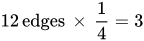
There are 36 positions. In total there are 16 particles in the unit cell, 8 of each type.
Particle Type A
Particle Type B
-
-
-
- Failed to parse (MathML with SVG or PNG fallback (recommended for modern browsers and accessibility tools): Invalid response ("Math extension cannot connect to Restbase.") from server "https://wikimedia.org/api/rest_v1/":): {\displaystyle \left(\frac{3}{4},\frac{3}{4},\frac{3}{4}\right)-\left(\frac{1}{2},\frac{1}{2},0\right)=\left(\frac{1}{4},\frac{1}{4},\frac{3}{4}\right)}




Examples
Atomics
- Sodium Thallium crystal (NaTl)
Nanoparticles
- Au NPs and proteins: Petr Cigler, Abigail K. R. Lytton-Jean, Daniel G. Anderson, M. G. Finn & Sung Yong Park DNA-controlled assembly of a NaTl lattice structure from gold nanoparticles and protein nanoparticles Nature Materials 9, 918–922 (2010) doi:10.1038/nmat2877

Cristobalite
Cristobalite is a diamond-like lattice formed in silicon dioxide (SiO2). The Si atoms bond tetradrally, each to four O atoms. Each O atom is bonded to 2 Si atoms, effectively acting as a bridge.
Structure
Can be thought of as a diamond lattice, where the tetrahedral species sit on the positions of the canonical diamond sites, and the two-bonded species sites at the midway point of each bond.


The tetrahedral species sit on the 14 "FCC" sites, plus 4 "internal" diamond sites. The two-bonded species sit on the 16 internal bonds in the unit cell. The tetrahedral species sit at a distance from one another of:
- Next-nearest-neighbor distance:

The different species thus have a distance of half that:
- Nearest-neighbor distance:

Particle Positions
There are 34 positions (24 in unit cell)
Particle Type A (bond tetrahedrally)
There are 18 positions. In total there are 8 particles in the unit cell:
-
- Failed to parse (MathML with SVG or PNG fallback (recommended for modern browsers and accessibility tools): Invalid response ("Math extension cannot connect to Restbase.") from server "https://wikimedia.org/api/rest_v1/":): {\displaystyle \left(0,0,0\right),(0,0,1),(0,1,0),(1,0,0),(0,1,1),(1,0,1),(1,1,0),(1,1,1)}
-
- Failed to parse (MathML with SVG or PNG fallback (recommended for modern browsers and accessibility tools): Invalid response ("Math extension cannot connect to Restbase.") from server "https://wikimedia.org/api/rest_v1/":): {\displaystyle 4 \, \mathrm{internal \,\, tetrahedral \,\, sites} \, \times \, 1 = 4}
- Failed to parse (MathML with SVG or PNG fallback (recommended for modern browsers and accessibility tools): Invalid response ("Math extension cannot connect to Restbase.") from server "https://wikimedia.org/api/rest_v1/":): {\displaystyle \left(\frac{1}{4},\frac{1}{4},\frac{1}{4}\right)+(0,0,0)=\left(\frac{1}{4},\frac{1}{4},\frac{1}{4}\right)}
- Failed to parse (MathML with SVG or PNG fallback (recommended for modern browsers and accessibility tools): Invalid response ("Math extension cannot connect to Restbase.") from server "https://wikimedia.org/api/rest_v1/":): {\displaystyle \left(\frac{1}{4},\frac{1}{4},\frac{1}{4}\right)+\left(0,\frac{1}{2},\frac{1}{2}\right)=\left(\frac{1}{4},\frac{3}{4},\frac{3}{4}\right)}
- Failed to parse (MathML with SVG or PNG fallback (recommended for modern browsers and accessibility tools): Invalid response ("Math extension cannot connect to Restbase.") from server "https://wikimedia.org/api/rest_v1/":): {\displaystyle \left(\frac{1}{4},\frac{1}{4},\frac{1}{4}\right)+\left(\frac{1}{2},\frac{1}{2},0\right)=\left(\frac{3}{4},\frac{3}{4},\frac{1}{4}\right)}
Particle Type B (two-fold bonded)
There are 16 positions (all 16 in the unit cell):
- Failed to parse (MathML with SVG or PNG fallback (recommended for modern browsers and accessibility tools): Invalid response ("Math extension cannot connect to Restbase.") from server "https://wikimedia.org/api/rest_v1/":): {\displaystyle 4 \, \mathrm{level \,\, one} \, \times \, 1 = 4}
- Failed to parse (MathML with SVG or PNG fallback (recommended for modern browsers and accessibility tools): Invalid response ("Math extension cannot connect to Restbase.") from server "https://wikimedia.org/api/rest_v1/":): {\displaystyle \frac{ (0,0,0)+\left(\frac{1}{4},\frac{1}{4},\frac{1}{4}\right) }{2} =\left(\frac{1}{8},\frac{1}{8},\frac{1}{8}\right)}
- Failed to parse (MathML with SVG or PNG fallback (recommended for modern browsers and accessibility tools): Invalid response ("Math extension cannot connect to Restbase.") from server "https://wikimedia.org/api/rest_v1/":): {\displaystyle \frac{ \left(\frac{1}{4},\frac{1}{4},\frac{1}{4}\right)+\left(\frac{1}{2},\frac{1}{2},0 \right) }{2} =\left(\frac{3}{8},\frac{3}{8},\frac{1}{8}\right)}
- Failed to parse (MathML with SVG or PNG fallback (recommended for modern browsers and accessibility tools): Invalid response ("Math extension cannot connect to Restbase.") from server "https://wikimedia.org/api/rest_v1/":): {\displaystyle \frac{ \left(\frac{1}{2},\frac{1}{2},0 \right) + \left(\frac{3}{4},\frac{3}{4},\frac{1}{4}\right) }{2} =\left(\frac{5}{8},\frac{5}{8},\frac{1}{8}\right)}
- Failed to parse (MathML with SVG or PNG fallback (recommended for modern browsers and accessibility tools): Invalid response ("Math extension cannot connect to Restbase.") from server "https://wikimedia.org/api/rest_v1/":): {\displaystyle \frac{ \left(\frac{3}{4},\frac{3}{4},\frac{1}{4}\right) + (1,1,0) }{2} =\left(\frac{7}{8},\frac{7}{8},\frac{1}{8}\right)}
- Failed to parse (MathML with SVG or PNG fallback (recommended for modern browsers and accessibility tools): Invalid response ("Math extension cannot connect to Restbase.") from server "https://wikimedia.org/api/rest_v1/":): {\displaystyle 4 \, \mathrm{level \,\, two} \, \times \, 1 = 4}
- Failed to parse (MathML with SVG or PNG fallback (recommended for modern browsers and accessibility tools): Invalid response ("Math extension cannot connect to Restbase.") from server "https://wikimedia.org/api/rest_v1/":): {\displaystyle \frac{ \left(\frac{1}{4},\frac{1}{4},\frac{1}{4} \right) + \left(\frac{1}{2},0,\frac{1}{2} \right) }{2} =\left(\frac{3}{8},\frac{1}{8},\frac{3}{8}\right)}
- Failed to parse (MathML with SVG or PNG fallback (recommended for modern browsers and accessibility tools): Invalid response ("Math extension cannot connect to Restbase.") from server "https://wikimedia.org/api/rest_v1/":): {\displaystyle \frac{ \left(\frac{1}{4},\frac{1}{4},\frac{1}{4} \right) + \left(0,\frac{1}{2},\frac{1}{2} \right) }{2} =\left(\frac{1}{8},\frac{3}{8},\frac{3}{8}\right)}
- Failed to parse (MathML with SVG or PNG fallback (recommended for modern browsers and accessibility tools): Invalid response ("Math extension cannot connect to Restbase.") from server "https://wikimedia.org/api/rest_v1/":): {\displaystyle \frac{ \left(\frac{3}{4},\frac{3}{4},\frac{1}{4} \right) + \left(1,\frac{1}{2},\frac{1}{2} \right) }{2} =\left(\frac{7}{8},\frac{5}{8},\frac{3}{8}\right)}
- Failed to parse (MathML with SVG or PNG fallback (recommended for modern browsers and accessibility tools): Invalid response ("Math extension cannot connect to Restbase.") from server "https://wikimedia.org/api/rest_v1/":): {\displaystyle \frac{ \left(\frac{3}{4},\frac{3}{4},\frac{1}{4} \right) + \left(\frac{1}{2},1,\frac{1}{2} \right) }{2} =\left(\frac{5}{8},\frac{7}{8},\frac{3}{8}\right)}
- Failed to parse (MathML with SVG or PNG fallback (recommended for modern browsers and accessibility tools): Invalid response ("Math extension cannot connect to Restbase.") from server "https://wikimedia.org/api/rest_v1/":): {\displaystyle 4 \, \mathrm{level \,\, three} \, \times \, 1 = 4}
- Failed to parse (MathML with SVG or PNG fallback (recommended for modern browsers and accessibility tools): Invalid response ("Math extension cannot connect to Restbase.") from server "https://wikimedia.org/api/rest_v1/":): {\displaystyle \frac{ \left(\frac{3}{4},\frac{1}{4},\frac{3}{4} \right) + \left(\frac{1}{2},0,\frac{1}{2} \right) }{2} =\left(\frac{5}{8},\frac{1}{8},\frac{5}{8}\right)}
- Failed to parse (MathML with SVG or PNG fallback (recommended for modern browsers and accessibility tools): Invalid response ("Math extension cannot connect to Restbase.") from server "https://wikimedia.org/api/rest_v1/":): {\displaystyle \frac{ \left(\frac{3}{4},\frac{1}{4},\frac{3}{4} \right) + \left(1,\frac{1}{2},\frac{1}{2} \right) }{2} =\left(\frac{7}{8},\frac{3}{8},\frac{5}{8}\right)}
- Failed to parse (MathML with SVG or PNG fallback (recommended for modern browsers and accessibility tools): Invalid response ("Math extension cannot connect to Restbase.") from server "https://wikimedia.org/api/rest_v1/":): {\displaystyle \frac{ \left(\frac{1}{4},\frac{3}{4},\frac{3}{4} \right) + \left(0,\frac{1}{2},\frac{1}{2} \right) }{2} =\left(\frac{1}{8},\frac{5}{8},\frac{5}{8}\right)}
- Failed to parse (MathML with SVG or PNG fallback (recommended for modern browsers and accessibility tools): Invalid response ("Math extension cannot connect to Restbase.") from server "https://wikimedia.org/api/rest_v1/":): {\displaystyle \frac{ \left(\frac{1}{4},\frac{3}{4},\frac{3}{4} \right) + \left(\frac{1}{2},1,\frac{1}{2} \right) }{2} =\left(\frac{3}{8},\frac{7}{8},\frac{5}{8}\right)}
- Failed to parse (MathML with SVG or PNG fallback (recommended for modern browsers and accessibility tools): Invalid response ("Math extension cannot connect to Restbase.") from server "https://wikimedia.org/api/rest_v1/":): {\displaystyle 4 \, \mathrm{level \,\, four} \, \times \, 1 = 4}
- Failed to parse (MathML with SVG or PNG fallback (recommended for modern browsers and accessibility tools): Invalid response ("Math extension cannot connect to Restbase.") from server "https://wikimedia.org/api/rest_v1/":): {\displaystyle \frac{ (1,0,1) + \left(\frac{3}{4},\frac{1}{4},\frac{3}{4}\right) }{2} =\left(\frac{7}{8},\frac{1}{8},\frac{7}{8}\right)}
- Failed to parse (MathML with SVG or PNG fallback (recommended for modern browsers and accessibility tools): Invalid response ("Math extension cannot connect to Restbase.") from server "https://wikimedia.org/api/rest_v1/":): {\displaystyle \frac{ \left(\frac{3}{4},\frac{1}{4},\frac{3}{4}\right) + \left(\frac{1}{2},\frac{1}{2},1 \right) }{2} =\left(\frac{5}{8},\frac{3}{8},\frac{7}{8}\right)}
- Failed to parse (MathML with SVG or PNG fallback (recommended for modern browsers and accessibility tools): Invalid response ("Math extension cannot connect to Restbase.") from server "https://wikimedia.org/api/rest_v1/":): {\displaystyle \frac{ \left(\frac{1}{2},\frac{1}{2},1 \right) + \left(\frac{1}{4},\frac{3}{4},\frac{3}{4}\right) }{2} =\left(\frac{3}{8},\frac{5}{8},\frac{7}{8}\right)}
- Failed to parse (MathML with SVG or PNG fallback (recommended for modern browsers and accessibility tools): Invalid response ("Math extension cannot connect to Restbase.") from server "https://wikimedia.org/api/rest_v1/":): {\displaystyle \frac{ \left(\frac{1}{4},\frac{3}{4},\frac{3}{4} \right) + (0,1,1) }{2} =\left(\frac{1}{8},\frac{7}{8},\frac{7}{8}\right)}
Examples
Atomics
- Cristobalite form of silicon dioxide (SiO2)

