Absorption length
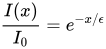
The absorption length or attenuation length in x-ray scattering is the distance over which the x-ray beam is absorbed. By convention, the absorption length ϵ is defined as the distance into a material where the beam flux has dropped to 1/e of its incident flux.
Contents
Absorption
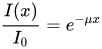
The absorption follows a simple Beer-Lambert law:
The attenuation coefficient (or absorption coefficient) is simply the inverse of the absorption length; Failed to parse (MathML with SVG or PNG fallback (recommended for modern browsers and accessibility tools): Invalid response ("Math extension cannot connect to Restbase.") from server "https://wikimedia.org/api/rest_v1/":): {\displaystyle \mu = 1/\epsilon}
Calculating
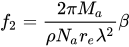
The absorption length arises from the imaginary part of the atomic scattering factor, f2. It is closely related to the absorption cross-section, and the mass absorption coefficient. Specifically, the atomic photoabsorption cross-section can be computed via:
- Failed to parse (MathML with SVG or PNG fallback (recommended for modern browsers and accessibility tools): Invalid response ("Math extension cannot connect to Restbase.") from server "https://wikimedia.org/api/rest_v1/":): {\displaystyle \sigma = 2 r_e \lambda f_2 }
Where λ is the x-ray wavelength, and re is the classical electron radius. The attenuation coefficient is given by:
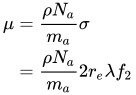
where ρ is density, Na is the Avogadro constant, and ma is the atomic molar mass. Note that the mass attenuation coefficient is simply .

Elemental dependence


Energy dependence
Notice that the absorption undergoes sharp increases when passing through an absorption edge.
Examples
silicon


gold


Elemental/Energy dependence


Related forms
As can be seen, there are many related quantities which express the material's absorption:
- Absorption length , the distance over which the intensity falls to 1/e.
- Attenuation coefficient , the characteristic inverse-distance for attenuation.
- Mass attenuation coefficient , the density-scaled attenuation.
- Absorptive atomic scattering factor , the intrinsic dissipative interaction of the material.
- Atomic photoabsorption cross-section , the cross-section ('effective size') of the atom's x-ray absorption (capture) efficiency.
- Imaginary refractive index , the resonant component of the refractive index.
- Imaginary Scattering Length Density , the absorptive component of the scattering contrast.


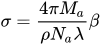
| Failed to parse (MathML with SVG or PNG fallback (recommended for modern browsers and accessibility tools): Invalid response ("Math extension cannot connect to Restbase.") from server "https://wikimedia.org/api/rest_v1/":): {\displaystyle \beta = \frac{ \rho \lambda }{4 \pi } \frac{\mu}{\rho}} | Failed to parse (MathML with SVG or PNG fallback (recommended for modern browsers and accessibility tools): Invalid response ("Math extension cannot connect to Restbase.") from server "https://wikimedia.org/api/rest_v1/":): {\displaystyle \beta = \frac{ \rho N_a r_e \lambda^2 }{2 \pi M_a} f_2} | Failed to parse (MathML with SVG or PNG fallback (recommended for modern browsers and accessibility tools): Invalid response ("Math extension cannot connect to Restbase.") from server "https://wikimedia.org/api/rest_v1/":): {\displaystyle \beta = \frac{ \rho N_a \lambda }{4 \pi M_a} \sigma} | Failed to parse (MathML with SVG or PNG fallback (recommended for modern browsers and accessibility tools): Invalid response ("Math extension cannot connect to Restbase.") from server "https://wikimedia.org/api/rest_v1/":): {\displaystyle \beta} | Failed to parse (MathML with SVG or PNG fallback (recommended for modern browsers and accessibility tools): Invalid response ("Math extension cannot connect to Restbase.") from server "https://wikimedia.org/api/rest_v1/":): {\displaystyle \beta = \frac{\lambda^2}{2 \pi} \mathrm{Im}(\mathrm{SLD})} | ||
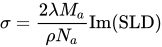
| Failed to parse (MathML with SVG or PNG fallback (recommended for modern browsers and accessibility tools): Invalid response ("Math extension cannot connect to Restbase.") from server "https://wikimedia.org/api/rest_v1/":): {\displaystyle \mathrm{Im}(\mathrm{SLD}) = \frac{1 }{2 \lambda \epsilon} } | Failed to parse (MathML with SVG or PNG fallback (recommended for modern browsers and accessibility tools): Invalid response ("Math extension cannot connect to Restbase.") from server "https://wikimedia.org/api/rest_v1/":): {\displaystyle \mathrm{Im}(\mathrm{SLD}) = \frac{\mu}{2 \lambda} } | Failed to parse (MathML with SVG or PNG fallback (recommended for modern browsers and accessibility tools): Invalid response ("Math extension cannot connect to Restbase.") from server "https://wikimedia.org/api/rest_v1/":): {\displaystyle \mathrm{Im}(\mathrm{SLD}) = \frac{\rho }{2 \lambda} \frac{\mu}{\rho}} | Failed to parse (MathML with SVG or PNG fallback (recommended for modern browsers and accessibility tools): Invalid response ("Math extension cannot connect to Restbase.") from server "https://wikimedia.org/api/rest_v1/":): {\displaystyle \mathrm{Im}(\mathrm{SLD}) = \frac{\rho N_a r_e }{M_a} f_2} | Failed to parse (MathML with SVG or PNG fallback (recommended for modern browsers and accessibility tools): Invalid response ("Math extension cannot connect to Restbase.") from server "https://wikimedia.org/api/rest_v1/":): {\displaystyle \mathrm{Im}(\mathrm{SLD}) = \frac{\rho N_a}{2 \lambda M_a}\sigma} | Failed to parse (MathML with SVG or PNG fallback (recommended for modern browsers and accessibility tools): Invalid response ("Math extension cannot connect to Restbase.") from server "https://wikimedia.org/api/rest_v1/":): {\displaystyle \mathrm{Im}(\mathrm{SLD}) = \frac{2 \pi }{\lambda^2} \beta} | Failed to parse (MathML with SVG or PNG fallback (recommended for modern browsers and accessibility tools): Invalid response ("Math extension cannot connect to Restbase.") from server "https://wikimedia.org/api/rest_v1/":): {\displaystyle \mathrm{Im}(\mathrm{SLD})} |






See also scattering factors for a comparison of the quantities related to f1.

